2024 Home-Grown Vegetable Contest
Fruit & Citrus Tree Sale
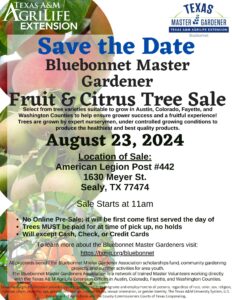
Fruit & Citrus Tree Sale
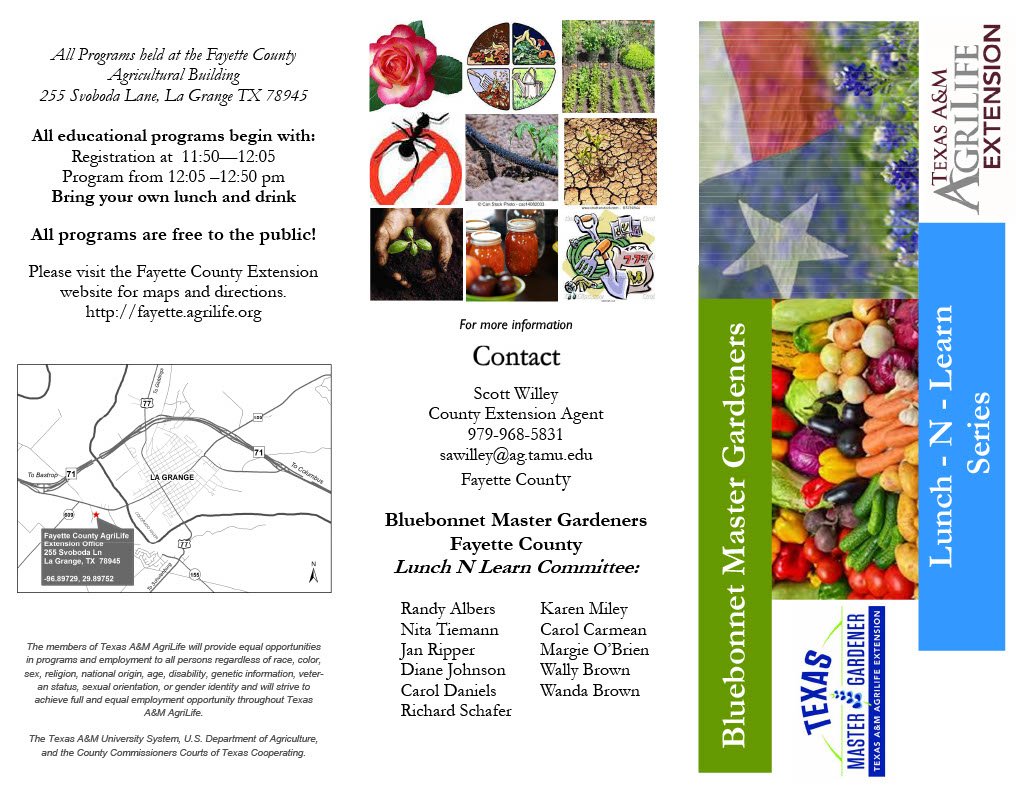
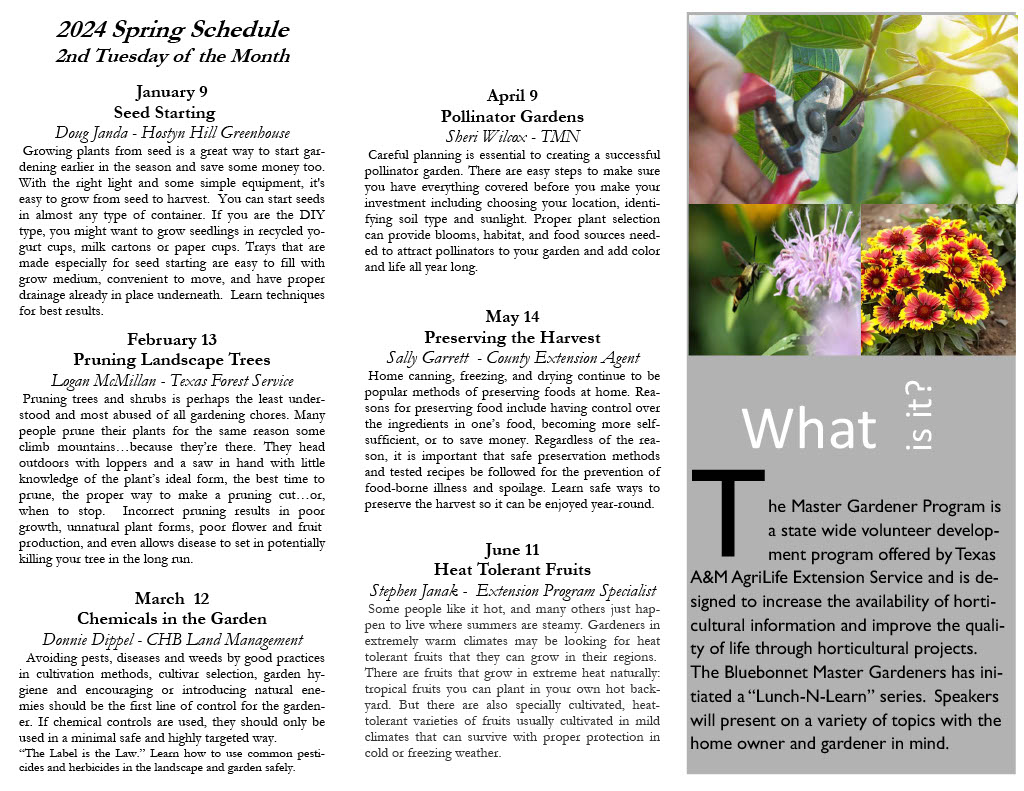
Lunch-N-Learn Fayette County
2024 Master Gardener Training Class Registration Open
 The Bluebonnet Master Gardener Association announces opening registration for it 2024 Master Gardener Certification Training Class.
Our 2024 Class is scheduled each Wedenday from January 10th – April 24th, 2024 with the final graduation class on Tuesday, April 23, 2024. The last class on April 24th is a Bonus Day including topics not contained in the standard training manuel.
Participants from Austin, Colorado, Fayette & Washington Counties are welcome to register for the class. The 50+ hours of classes will be held at the Washington County Expo Event Center at 1305 East Bell Road, Brenham, Texas 77833.
Details of field trips for on-site learning will be announced in class. The Master Gardener Handbook, compiled by the Texas Master Gardener Association, is included in the $200 registration fee. You may register online below or contact the Washington County Extension office at (979) 277-6262 for more information.
Class size is limited to 25.
For more information about the Master Gardener Program and to apply for the class, HERE

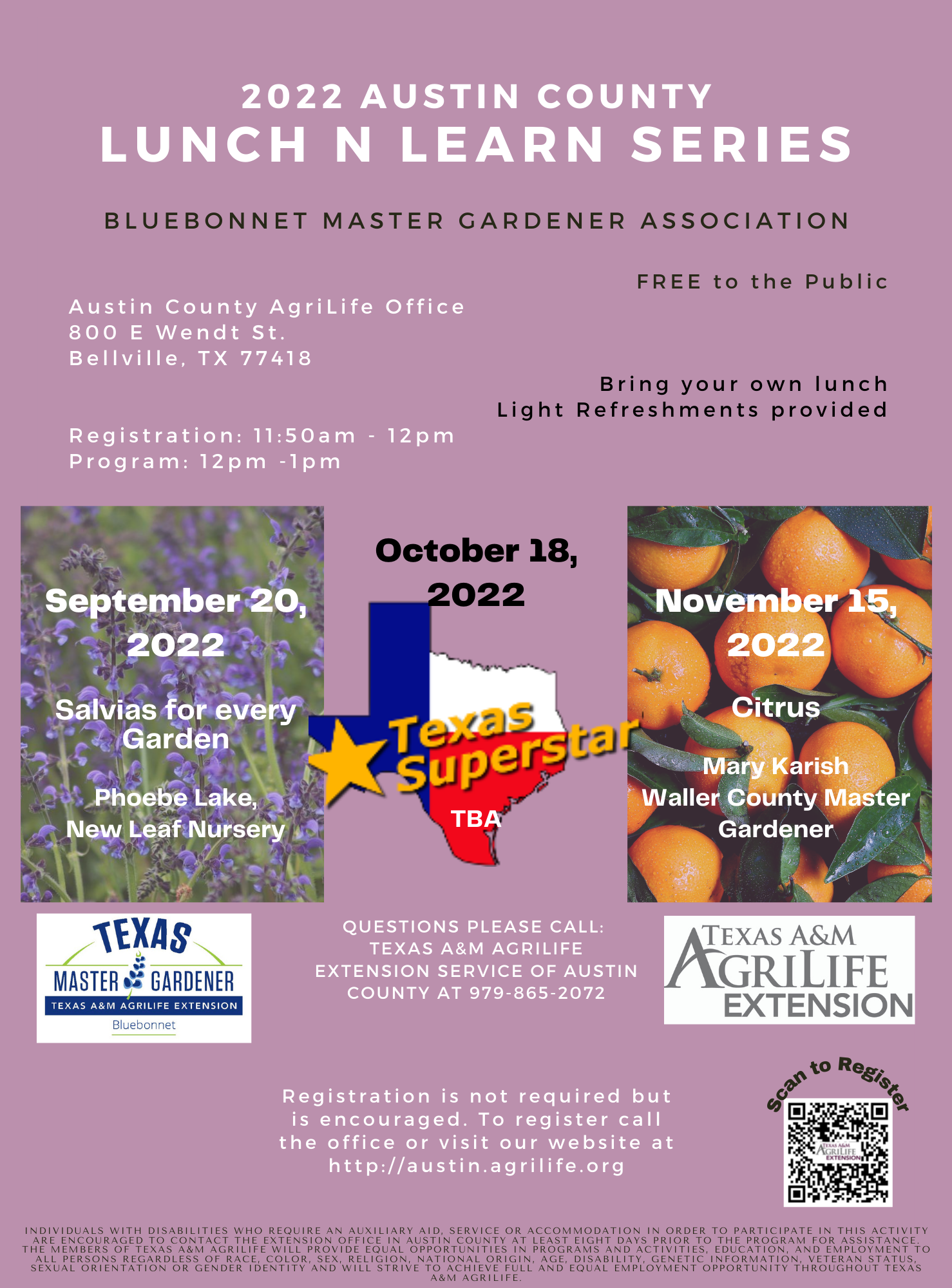
Austin County Lunch & Learn – Citrus
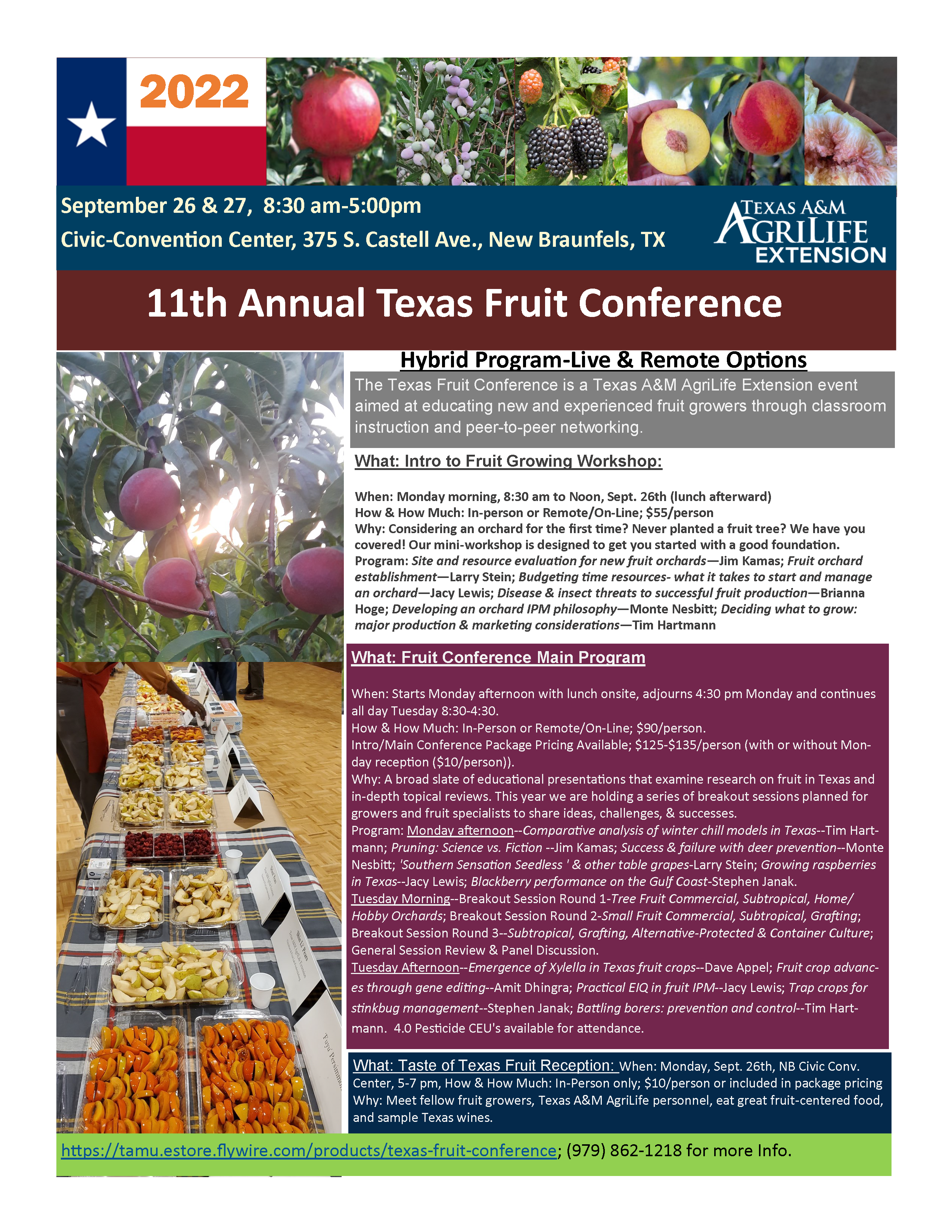
11th Annual Texas Fruit Conference
Hybrid Program-Live & Remote Options!
September 26 & 27, 2022, 8:30 a.m. – 5:00 p.m.
Civic-Consvention Center
375 S. Castell Ave.
New Braunfels, TX
For more information, visit:
https://tamu.estore.flywire.com/products/texas-fruit-conference
or call 979-862-1218
Texas Olive Update & Grower’s Seminar
When: Sept. 30, 2022 8:30 a.m. – 1:00 p.m.
Where: Texas A&M AgriLife Extension Research & Extension Center, Uvalde
1619 Garner Field Rd
Uvalde, Tx 78801
Space is limited so RSVP now at: tx.ag/TxOliveUpdate

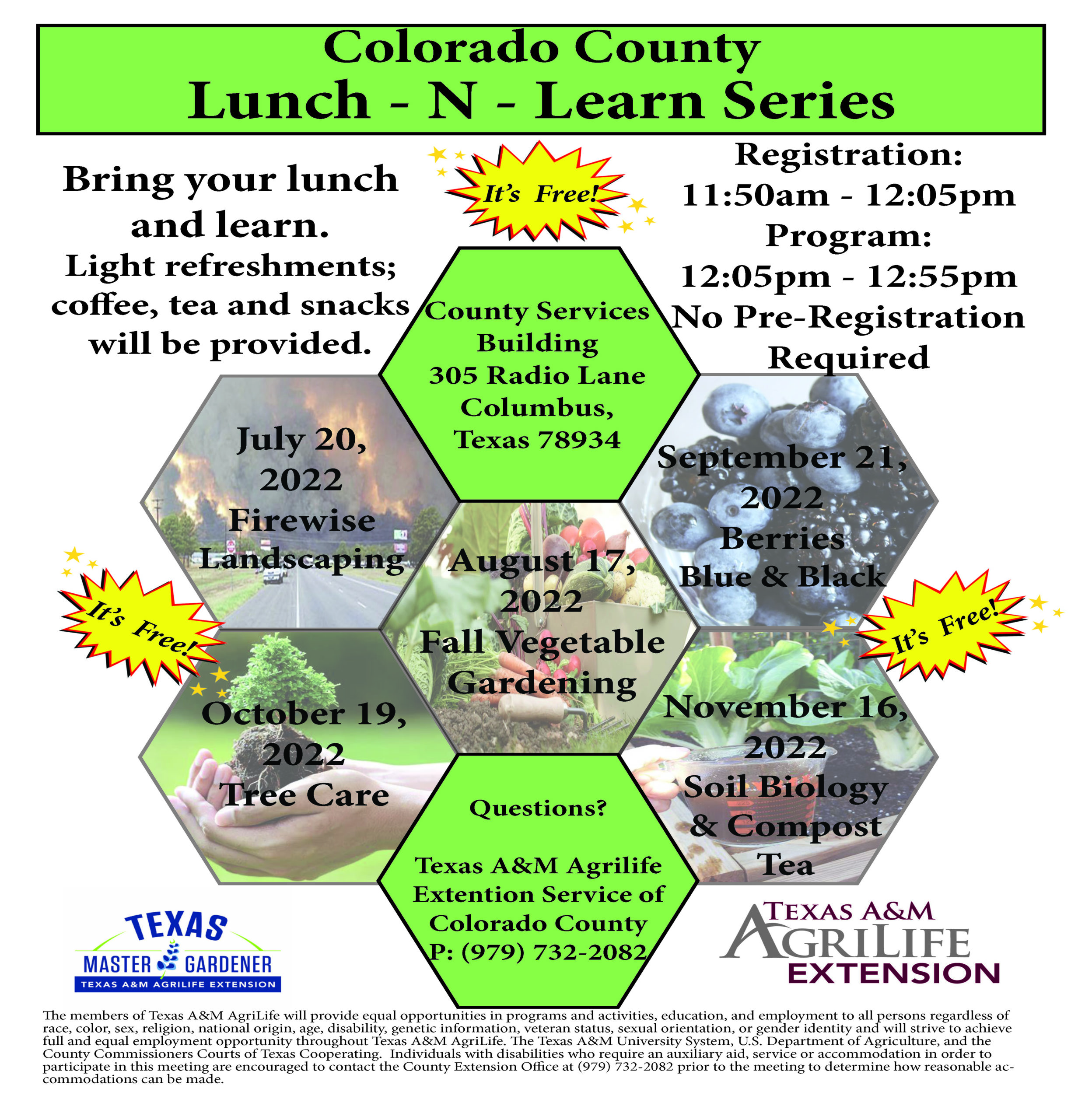
Colorado County Lunch-N-Learn Series
Colorado County members of the Bluebonnet Master Gardener Association are pleased to announce the upcoming Colorado County Lunch-N-Learn Series focused on gardening and horticulture!
Programs will be held on the 3rd Wednesday of each month at the Colorado County Services Facility located at 305 Radio Lane in Columbus. Registration will open at 11:50 am with the program starting promptly at 12:05 pm and ending by 12:55pm. Attendees are asked to bring their own lunch. Light refreshments including coffee, tea and snacks will be provided. No preregistration is required for this free program.
The following is our program line-up:
-
- July 20th – Firewise Landscaping
- August 17th – Fall Vegetable Gardening
- September 21st – All About Berries: Blackberries and Blueberries for the Home Gardener
- October 19th – Tree Care
- November 16th – Soil Biology and Compost Tea
For more information please contact the Colorado County AgriLife Extension Office at 979-732-2082.
Fruit & You in ’22! Agrilife Texas Fruit Conference
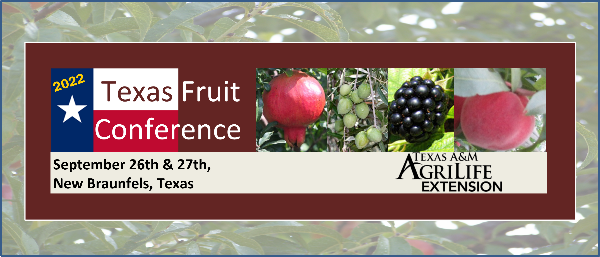
Fruit & You in ’22!
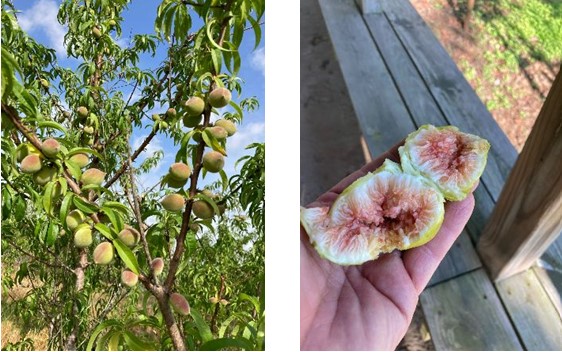
The Texas Fruit Conference is returning for its 11th year, and we would love to have all fruit growers and enthusiasts join us for two days of education, networking, and fruit sharing!
When: Monday, September 26th and Tuesday, September 27th
Where: New Braunfels Civic Convention Center, New Braunfels, Texas
What: New grower information, advanced orchard management topics, research on new and existing fruit crops, fruit variety performance, pesticide CEU’s, and our Taste of Texas Fruit Reception!
Contact: Monte Nesbitt, Texas A&M AgriLife Extension Horticulture, 979-862-1218, [email protected]
2021 Fall Citrus Tree Sale SOLD OUT
 All Trees are SOLD OUT
Only varieties suitable for growing in the Austin, Colorado, Fayette and Washington Counties are offered. Orders accepted from August 27, 2021 to September 7, 2021.
Pick-up: Buyer must pick-up trees:
September 10, 2021
12 noon – 3:00 p.m.
American Legion Post
1630 Meyer St.
Sealy, Texas 77474
2021 Fall Citrus Tree Sale! SOLD OUT
The Bluebonnet Master Gardener Association will kicks-off its Fall 2021 Citrus Tree Sale today.
Links to Citrus Growing Expert Resources:
Ambrosia from your Backyard, Growing Citrus on the Upper Coast of Texas
All Trees are SOLD OUT.
Only varieties suitable for growing in the Austin, Colorado, Fayette and Washington Counties are offered. Orders accepted from August 27, 2021 to September 7, 2021.
Pick-up: Buyer must pick-up trees:
September 10, 2021
12 noon – 3:00 p.m.
American Legion Post
1630 Meyer St.
Sealy, Texas 77474
2021 Fall Horticulture Seminar
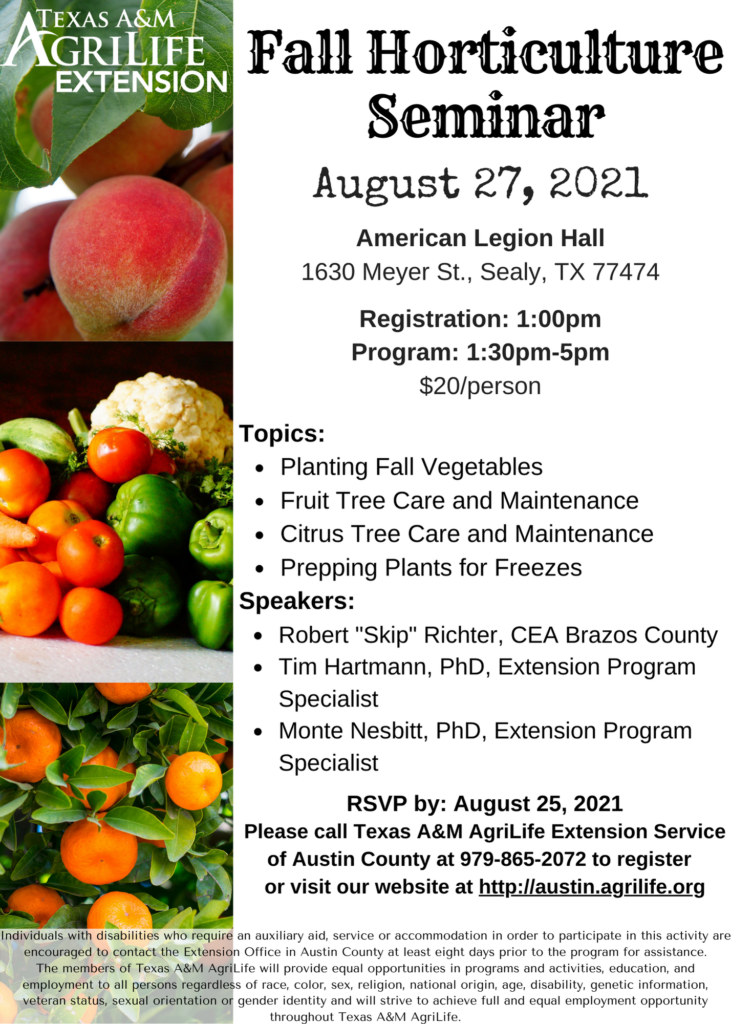
Please join Texas A&M Agrilfe Extension Service August 27, 2021 for the Fall Horticulature Seminar, hosted by Texas A&M Agrilfe Extension Service for Austin County. Topics, which will be presented by AgriLife Extentions Agent Robert “Skip” Richter and Specialists Tim Hartmann, Ph.D and Monte Nesbitt, Ph.D include:
Planting Fall Vegetables
Fruit Tree Care and Maintenance
Citrus Tree Care and Maintance
Prepping Plants for Freezes
RSVP HERE by August 25, 2021 or call 979-865-2072.
Plant Picturepages by Aggie Horticulture
 Sometimes, the answer is just knowing where to look; and someitimes, a picutre is just what you need to answer the question. With the help of many collaborators, Aggie Horticulture assembled a few theme-oriented searchable databases for use in their classes and for the public to use and enjoy. If you have not checked out Aggie Horticulture’s Plant Picturepages, the link is below. Find the information you need in pictures or just enjoy the many horticulature related sites and photos.
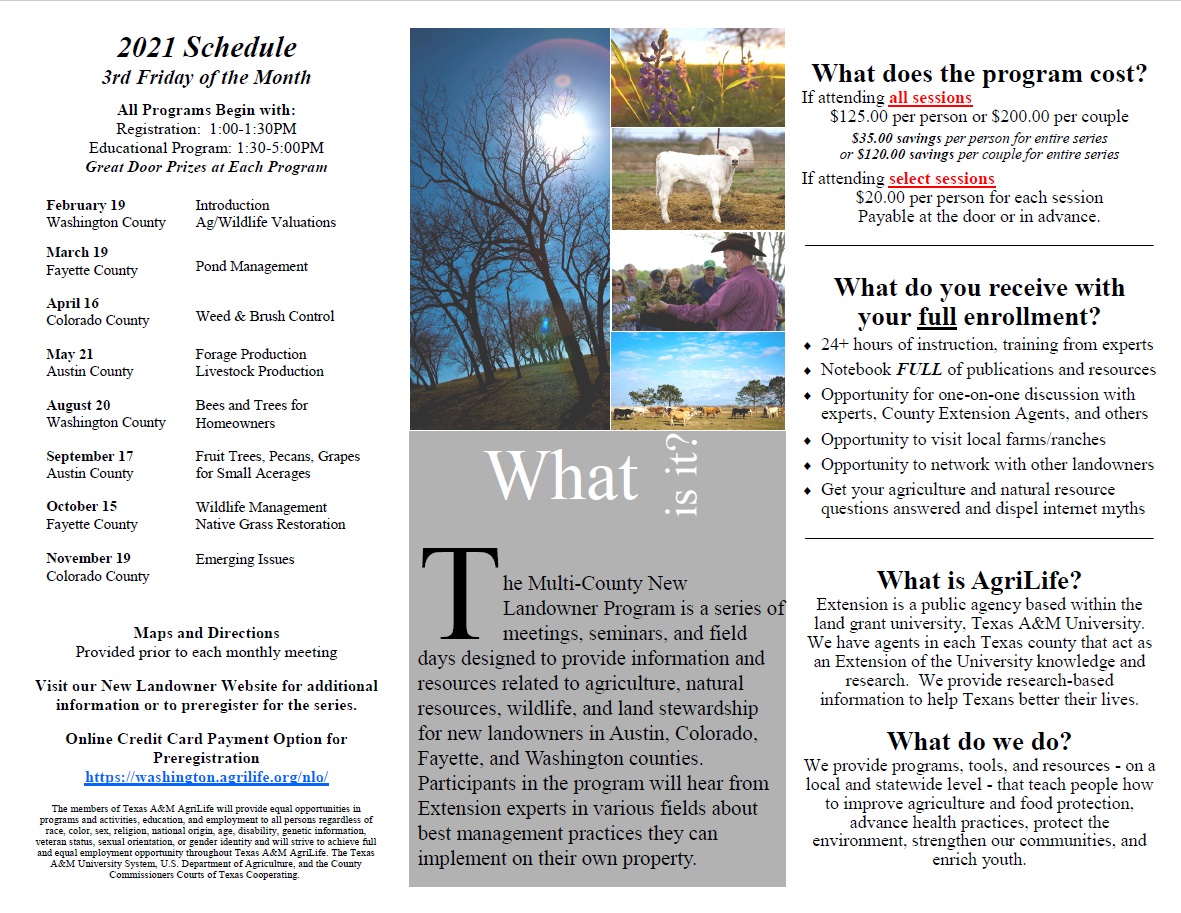
Multi-County New Landowner Program: Trees, Pecans, Grapes for Small Acreages
Ask an Expert is now Ask Extension

Ask an Expert is now Ask Extension. This service offers one-to-one expert answers from Cooperative Extension/University staff and volunteers within participating Land-Grant institutions from across the United States. Before posting a new question, you may also search previously answered questions in the Knowledgebase catalogue.
DO YOU HAVE A QUESTION FOR EXTENSION EXPERTS?
Frozen Plants? Aggie Horticulture Facebook Live Events
Texas A&M Extension Horticulture faculty are using their weekly Facebook live events and one additional event to talk about the freeze and what to expect with plants. The schedule will be as follows:
Wednesday 1:00 p.m. Ornamentals & Vegetables
Friday 1:00 p.m. Fruit
Friday 4:00 p.m. Turf
These events can be found on Facebook on the Aggie Horticulture page and will be useful information for Master Gardeners and the public. All events are free and open to the public.
Online Horticulture Learning Could Never be Easier
So many online horticulture learning opportunities you don’t know where to start? This guide can get you started learning from horticulture experts.
Texas A&M AgriLife Extension recorded many of their programs for viewing on your own schedule. These recorded presentations are free to the public.
Bluebonnet Master Gardener Association members may claim Continuing Education Units (CEU) for these all AgriLife programs that pertain to gardening and horticulture; live or recorded. Just watch the presentation and record your time as CEU. BMGA members, remember to get your CEU credits recorded by December 31, 2020 to apply those hours to your re-certification requirement. For 2020, you need 6 CEU credits.
Below are links to some of these programs to start learning from our Aggie experts.
Gulf Coast Gardening Online Series
There are 22 videos for more than 24 hours of learning. Topics include:
Young Tree Care – Video #5
Earth Kind Pest Disease & Weed Control – Video #10
Texas Superstar Plants – Video #19
Horticulture & Gardening Webinar Series with David Rodriguez, County Extension Horticulture Agent, Bexar County
There are currently 17 of these recorded sessions for more than 13 hours of education. Topics include:
Getting Your Lawn and Landscape Ready for Summer Heat – Video #9
Tomato Basics 101 – Video #13
Butterfly Gardening – Nectar Plants – Video #5
Aggie Horticulture Facebook Live Recordings
There are 55 horticulture recorded events. Wow! You do not need a Facebook account to watch. Topics include:
Homeowner Greenhouses- Video #41
Transitioning to a Fall Garden, Two Parts – Video #40 & #45
Toys for Vegetable Gardening – Video #50
Fall Blooming Flowers & Biennials Planted in Fall – Video #51
Growing Blueberries in Containers – Video 18
Fall 2020 Fruit Tree Sale – Order Online
UPDATE: Orders Open to October 9, 2020

The Bluebonnet Master Gardener Association will kick-off its Fall 2020 Fruit Tree sale on September 28. Revisit this page to order and for updated information. In the meantime, review the tree list and plan your order!
Only varieties suitable for growing in the Austin, Colorado, Fayette and Washington Counties are offered. Orders accepted from September 28, 2020 to October 9, 2020.
Pick-up: Buyer must pick-up trees between 3:00 p.m. – 5:30 p.m. Friday, October 16, 2020 at one of the following locations, chosen when the order is placed:
Note Pick-up Locations
Austin County Colorado County
Koehler Ranch Colorado County Extension Office
1333 Downey Rd. 316 Spring Street
Sealy, TX 77474 Columbus, Texas 78934
Fayette County Washington County
AgriLife Building Washington County Fairgrounds-VIP Building
255 Svoboda Ln 1305 E. Blue Bell Rd
La Grange, TX 78945 Brenham, TX 77833-2436
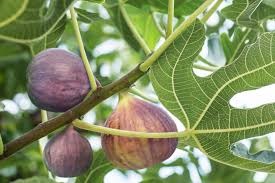
Everything listed will grow well in our area however, lemons must be protected from frost and freezing weather. Figs and citrus have to be protected when they are young.
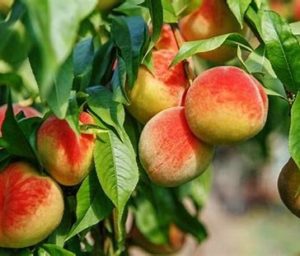
Please note that the Chocolate Persimmon isn’t really chocolate. It just has brown stripes on the orange fruit.
Available Trees & Prices – 3 Gallon Containers
Availability may be limited
- APPLE – FUJI $24
- AVOCADO – LILA $58
- AVOCADO – PANCHO $58
- BLUEBERRY – CLIMAX $22
- BLUEBERRY – PREMIER $22
- BLUEBERRY – TIFBLUE $22
- DWARF IMPROVED MEYER LEMON $58
- DWARF KEY LIME $58
- DWARF PERSIAN LIME $58
- DWARF ORANGE NAVAL N-33 $58
- FIG – CELESTE $24
- FIG – TEXAS EVERBEARING $24
- GINGER – CULINARY $24
- GOJI BERRY $24
- LEMON – IMPROVED MEYER $44
- LEMON – LEMONADE $44
- LOQUAT $24
- ORANGE – VALENCIA RHODE RED $44
- PEACH – FLORIDAKING $32
- PEACH – LA FELICIANA $32
- PEAR – SHINSEKO $32
- PERSIMMON – GIANT FUYU $38
- PERSIMMON – CHOCOLATE $38
- POMEGRANITE – SALAVATSKI $38
- PUMMELO – CHANDLER $44
- SATSUMA – MIHO $44
- SATSUMA – OWARI FROST $44
Variety Descriptions
Apple, Fuji– 400 – 600 chill hours, yellow-green skin with red stripes. Ripens in early fall. More tasty than the red Fuji. Allow to ripen on the tree.
Avocado, Lula – Green skinned medium sized fruit. Ripens in late October-January. Hardy to about 24 degrees. Full sun
Avocado, Pancho – Originated as a seedling at Stuart Place, TX. The fruit is oval to slightly pear shaped and is light green in color with a very thin skin. Medium sized fruit. Cold hardy to mid teens, ripens Aug – September.
Berry, Goji- Nutritional and Medical benefits. Super food high in antioxidants. Known to promote longevity
Blueberry, Climax – rabbiteye blueberry, which is early ripening. Most of the fruit ripens in a short period of time. The crop load is moderate to high. 310-420 Chill hours. Requires a pollinator.
Blueberry, Premiere – This variety is an early season rabbiteye variety, that produces fruit of excellent color, size and flavor. The bushes are vigorous and productive, and have been suited to mechanical harvesting. 310-420 chill hours. Requires a pollinator.
Blueberry, TifBlue – is the most universally outstanding rabbiteye blueberry grown to date. The fruits are large, light blue and ripen late in the season. The bush is vigorous and very productive. Tifblue is more cold hardy than most rabbiteye blueberries varieties. 350-400 chill hours. Self fruitful
Fig, Celeste – medium sized sweet fruit, ripens in July. Requires lots of water with good drainage
Fig, Texas Everbearing (Brown Turkey) – medium sized fruit that is nearly seedless, mild sweet flavor
Ginger, Zingiber “Baby Ginger”– Great selection of yellow edible ginger, tender with mild flavor, does not need to be peeled.
Loquat, Japanese Plum – Evergreen tree. Tangy and sweet fruit. Can get 20-30 feet tall. Rich in vitamins, minerals and antioxidants.
Mulberry, Dwarf Everbearing- Sweet medium sized berry, Produces continuously in warm bright conditions, strengthens immune system, great for eyesight.
Peach, Flordaking – High quality, early season peach, large semi-freestone sweet fruit, 450 chill hours or less
Peach, La Feliciana- Heavy bearer of high quality fruit. Firm and flavorful. Yellow fleshed freestone. 550-600 chill hours.
Pear, Shinseiki– juicy, sweet crisp Asian pear with bright yellow-skin. 12 – 16’. Vigorous and heavy bearing. Cold Hardy, self fruitful best with pollinator. Resistant to fire blight.
Persimmon, Chocolate – Large fruit, delicious flavor, has chocolate brown stripes on orange skin. Ripens in September. Acorn shaped.
Persimmon, Giant Fuyu – Orange fruit is larger than the regular Fuyu and just as good. Ripens in October and November. Non-astringent, crisp and sweet.
Pomegranate, Salavatski – 6 – 8’ tall, heavy producer, slightly dwarf, fruit has hard seeds with sweet tart juice, self fruitful. Produces bright orange flowers edible over an extended time. Cold Hardy.
Citrus
Lemon, Improved Meyer – sweet and tangy, medium size fruit, thin yellow skin, very juicy. Least cold sensitive of all the lemons, but still needs to be protected from freeze.
Lemon, New Zealand Lemonade – delicious, sweet lemon hybrid with few seeds, very productive, very large fruit
Orange, Valencia Rhode Red – great for juicing, harvest between March & June. Only variety of orange in season during summer.
Pummelo, Chandler – large tree, dark green winged leaves, very large fruit, flesh is pink & sweet. Ripens in November
Satsuma, Miho – cold hardy, medium to large fruit, seedless, good flavor. Ripens in September and October.
Satsuma, Owari Frost – very cold hardy, medium sized sweet, seedless fruit, keeps well on the tree, ripens in early October
Dwarf Varieties
Dwarf Varieties are 30 to 40% smaller than standard trees which make them easier to grow in pots and to protect from the cold. They do well in a garden setting, have standard size fruit and are easier to pick.
Dwarf Improved Meyer Lemon – compact tree, medium size fruit, thin yellow skin, very juicy. Least cold sensitive of all the lemons, but still needs to be protected from freeze.
Dwarf Key Lime – Extremely cold sensitive, small tangy fruit, tasty
Dwarf Lime, Persian – dark foliage, medium-large fruit with delicious juicy flavor.
Dwarf Orange, Navel N-33 – fruit has thick orange rind, rich flavor, juicy & seedless
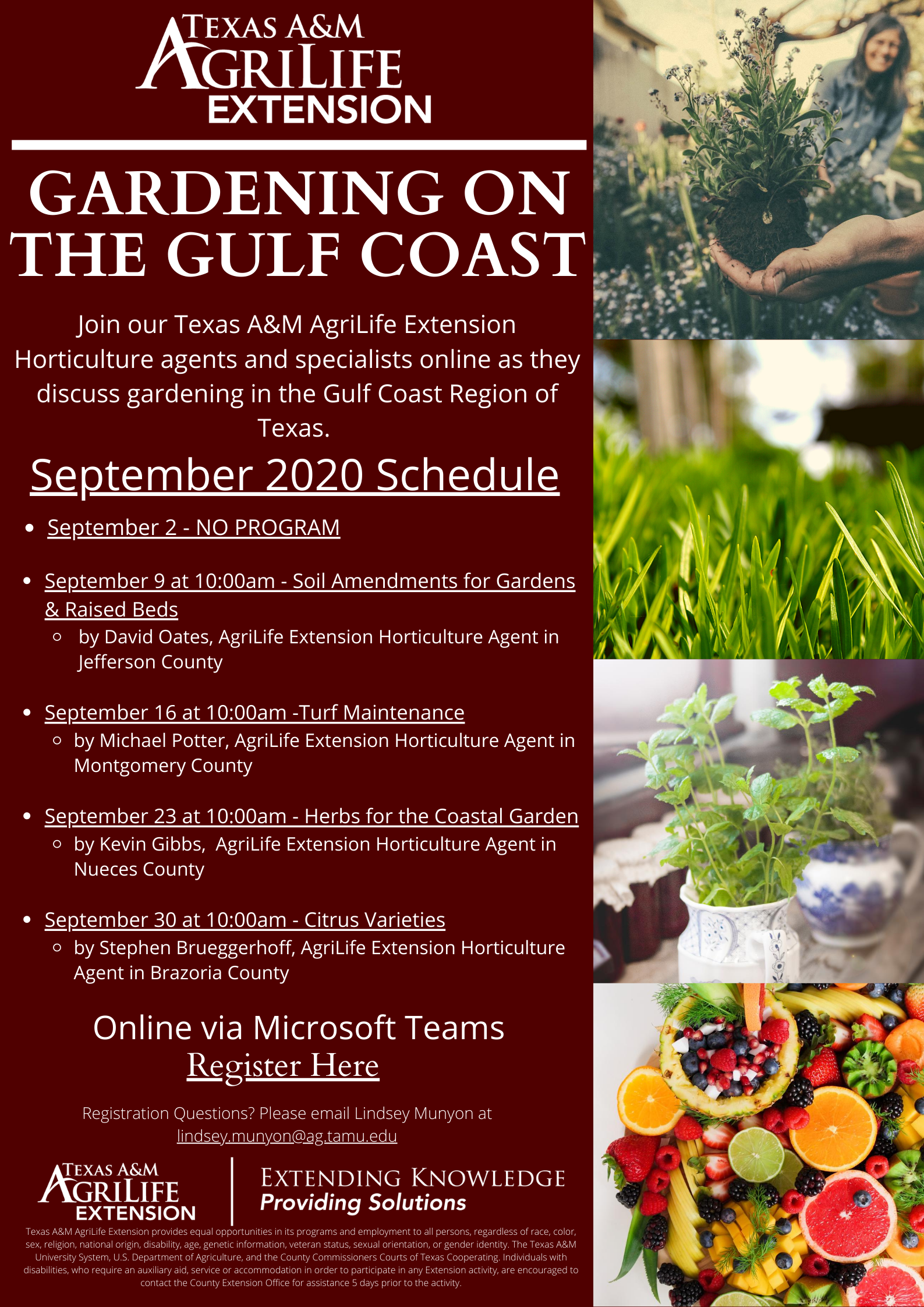
Gardening on the Gulf Coast-September 2020 Online Schedule
9th Annual Texas Fruit Conference – Online
Texas AgriLife Extension announced today that The 9th Annual Texas Fruit Conference on September 21st and 22nd will be held On-line, rather than in person. The program is committed to providing an easily-accessible, Online web conference that will be practical and educational for the diverse Texas fruit growing community’s needs.
The tentative program plan is as follows:
Session 1, Monday, September 21st: 1 pm to 5:00 pm: Intro to Fruit Growing Workshop—a crash course in starting a fruit orchard—crop and variety options, soil and water evaluation, orchard design, planting, irrigation etc.
Session 2, Tuesday, September 22nd: 9 am to 11:30 am: Texas’ Fruit Future—a series of presentations aimed at new growing practices, new crops and new marketing strategies (Titles and speakers to be determined)
1:30 pm to 3:00 pm: Experiences in Growing Fruit Trees—a virtual field trip to one or more established fruit growers in Texas (Site(s) to be announced)
3:30 pm to 5:00 pm: Hard Questions—Good Answers—Live panel discussion with Texas A&M AgriLife Extension Fruit Team
Registration Fee:
Monday (9/21) Only: Intro to Fruit Growing Workshop: $50
Tuesday (9/22) Only: Texas’ Fruit Future, Experiences in Growing Fruit Trees, Hard Questions/Good Answers: $35
Combination package: both sessions $70.00
Registration site: http://Agriliferegister.tamu.edu/ (Registration begins 8/14/2020)

For more information contact:
Monte Nesbitt
Horticultural Sciences
[email protected]
Tomato 101: The Basics of Growing Tomatoes – Online Course
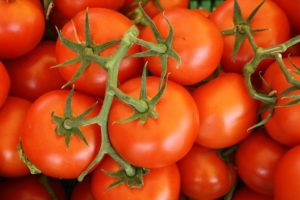 Tomatoes are the most popular garden edible crop in Texas according to Joseph Masabni, Assistant Professor and Extension Horticulturist, The Texas A&M University System. Although the jewel of the Texas garden, many home gardeners have disappointing results with tomatoes.
Texas A&M AgriLife Extension’s online course Tomato 101: The Basics of Growing Tomatoes teaches the basics of growing tomatoes in your garden. You may cover the material at your own pace and on your own time schedule so begin when you’re ready. This course was first developed for Texas gardeners. However, most information is suitable for other regions.
The cost of the course is $20.00
See all available AgriLife online courses under the Plants and Garden.
Gulf Coast Gardening Online Series – Free

Join Texas A&M AgriLife Extension Horticulture agents and specialists as they discuss gardening in the Gulf Coast Region of Texas. Mark your calendars for these CEU opportunties.
Register to attend live events:
Link to recorded past events CLICK HERE
July 2020
July 1 at 10:00am – Home Citrus Growing by Ginger Easton-Smith, AgriLife Extension Ag and Natural Resources Agent in Aransas County
July 8 at 10am – Young Tree Care by Boone Holladay, AgriLife Extension Horticulture
July 15 at 10am – Cacti & Succulent Varieties by Kevin Gibbs, AgriLife Extension Horticulture
July 22 at 10am – Fabulous Figs for the Gulf by Stephen Brueggerhoff, AgriLife Extension Horticulture Agent in Brazoria County
July 29 at 10am – EarthKind Pest, Disease & Weed Control by Robert “Skip” Richter, AgriLife Extension Horticulture Agent in Brazos County
June 2020
June 3 at 10:00am – Annuals in the Summer Heat by Paul Winski, AgriLife Extension Horticulture Agent in Harris County
June 10 at 10:00am – Olives on the Texas Gulf Coast by Stephen Janak, Extension Program Specialist
June 17 at 10:00am – Gardening in Containers by Skip Richter, AgriLife Extension Horticulture Agent in Brazos County
June 24 at 10:00am – Turf Irrigation Audit by Michael Potter, AgriLife Extension Horticulture Agent in Montgomery County