• Skip to primary navigation
  • Skip to main content
  • Skip to primary sidebar
  • Texas A&M Forest Service
  • Texas A&M Veterinary Medical Diagnostics Laboratory
  • Texas A&M AgriLife Extension Service
  • Texas A&M AgriLife Research
  • Texas A&M College of Agrculture and Life Sciences
Bluebonnet Master Gardener Association
Bluebonnet Master Gardener AssociationTexas AgriLife Extension Service

Members Only   Enter Hours

  • Menu
  • #5 (no title)
  • About
  • Calendar
  • Projects
  • Resources
  • News Blog
  • Training Class
  • Contact Us

Master Gardeners Teach Students About Monarch Butterflies

November 14, 2023 by cmschweikhardt

Article and photos submitted by Teresa Wilson.

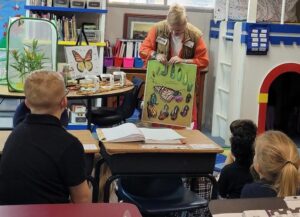
Nancy Galloway explaining the butterfly life cycle.

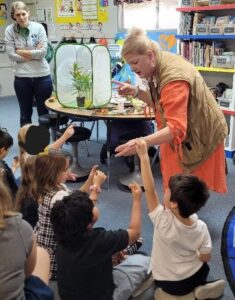
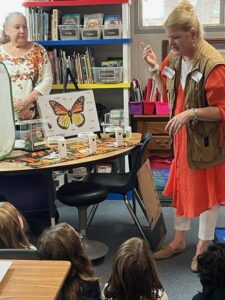
Students at Citadel Christian School in Brenham, Texas had the opportunity to learn about Monarch butterflies through two educational programs lead by Bluebonnet Master Gardener Assocation member Nancy Galloway, with assistance from Teresa Wilson and Mandy Ames, also Master Gardeners.  Both programs were held at the school on Novebmer 6, 2023.

The first program was for students in grades 1 through 4. It featured a detailed display illustrating theMonarch butterfly’s life cycle, from egg to butterfly, along with a live butterfly exhibit. Nancy, clad in signature Monarch orange top with a light brown field vest mimicing the colors of the Monarch, covered aspects of the north and south Monarch migrations, explaining the life cycle and yearly generational patterns.

Nancy Galloway leading class with Mandy Ames looking on.

Students were also given the chance to practice tagging Monarchs for research purposes, using simulated butterflies. In a practical demonstration, Nancy tagged a Monarch she caught earlier that day in her garden, with hopes that it would be found in Mexico, contributing to migration data.

Nancy Galloway talking with the class; Teresa Wilson looking on.

The second presentation was tailored for 10th-grade students who already had some knowledge of Monarchs. Nancy delved into the habits, nutrition, nesting needs, pests, and diseases associated with Monarchs. The class is now planning to create a natural area with milkweed, following Nancy’s recommendations, to establish a Monarch waystation habitat.

Nancy Galloway’s adeptness in adjusting lecture levels to suit the audience made the presentations informative. Teachers at the school also received educational packets to support ongoing learning.

This presentation was part of the Bluebonnet Master Gardener Association’s work to provide garden-related education at the school.

Filed Under: Other Tagged With: Kids, Pollinators

Tips for Safe Gardening in Extreme Heat Conditions

July 6, 2023 by cmschweikhardt

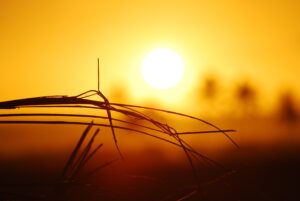
Sun and dried grassExtreme heat makes for difficult gardening conditions for both the plants and the gardener. As gardeners, we focus on helping our plants and gardens survive the heat of Texas summer but also, we must also take steps to protect ourselves from the heat. More 100+ degree days are forcast for our area this summer.  Spending hours in such heat can pose serious health risks to gardeners. Heat-related illnesses like heat exhaustion and heatstroke can be debilitating or even life-threatening.
Here are a few tips to help reduce heat-related illness while gardening in the extreme heat:

Dress Appropriately: Wear lightweight, loose-fitting, and light-colored clothing that allows air circulation. Long sleeves and pants can protect the skin from direct sun exposure and reduce the risk of sunburn. Additionally, a wide-brimmed hat and sunglasses can shield the face and eyes from harmful UV rays.

Hydration: Hydration is essential when working in hot conditions. Drink plenty of water before, during, and after gardening to replace fluids lost through sweat. Avoid excessive consumption of caffeinated or alcoholic beverages while in the heat, as they contribute to dehydration.

Time of Day: Schedule gardening activities during the cooler parts of the day, typically early morning or early evening. Avoid working during peak sunlight hours of 10:00 a.m. to 4:00 p.m when temperatures are at their highest. Take regular breaks in the shade or air conditioning to rest and cool down.

Use Sunscreen: Apply broad-spectrum sunscreen with a minimum SPF of 30 on exposed skin, at least 30 minutes before going outside to reduce the risk of skin cancer.  Sunscrean helps prevent UV-ray-damage to the skin which can cause cancer and  “thin” skin that tears and bleeds easily. Reapply sunscreen every two hours, or more frequently if sweating heavily.

Seek Shade & Air Conditioning: Use natural shade from trees and tall plants in the garden or create a shade structure in the garden. Take frequent breaks in shaded areas or go inside to the air conditioning to lower your body temperature and minimize the risk of overheating.

Although we garden year-around in Texas, July and August are probbaly the most challenging physcially for both the plants and for us.  By taking a few precautions to prevent heat-related illnesses, gardeners can continue to find joy in the garden even in the hash temperatures of summer.  Stay cool out there gardeners!


Filed Under: Other

New Texas Superstar Brochure

June 30, 2023 by cmschweikhardt

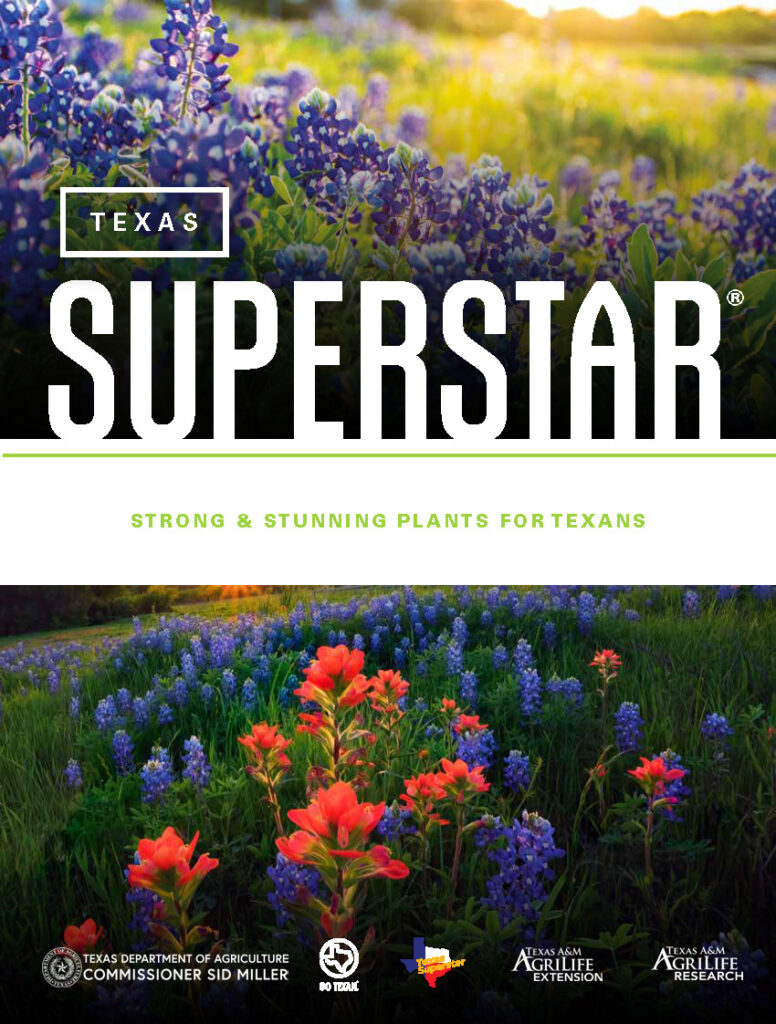
The Texas Superstar brochure is updated.  The new brochure is a beautiful, full color 44-page booklet with detailed descriptions, suggested uses and special notes for each plant with the Texas Superstar® designation. Texas Superstar: Strong & Stunning Plants for Texans

Link to the Texas Superstar: Strong & Stunning Plants for Texans brochure

You may print, download, view it in your browser or on device.  Be sure to have it available when planning your landscape and vegetable gardens.

To be designated a Texas Superstar®  a plant must be beautiful and perform well for growers throughout the state. Texas Superstars must also be easy to propagate, ensuring the plants are widely available and reasonably priced.
Texas Superstar® is a registered trademark owned by Texas A&M AgriLife Research, a state agency that is part of the Texas A&M University System. Plants are designated Texas Superstars by the Texas Superstar executive board, made up of nine horticulturalists from AgriLife Research, Texas A&M AgriLife Extension Service and Texas Tech University.

Filed Under: Other Tagged With: Earth-Kind, TexasSuperstars, Trees, Vegetables

Bluebird Eggs at Sens Center Demo Garden

April 13, 2023 by cmschweikhardt


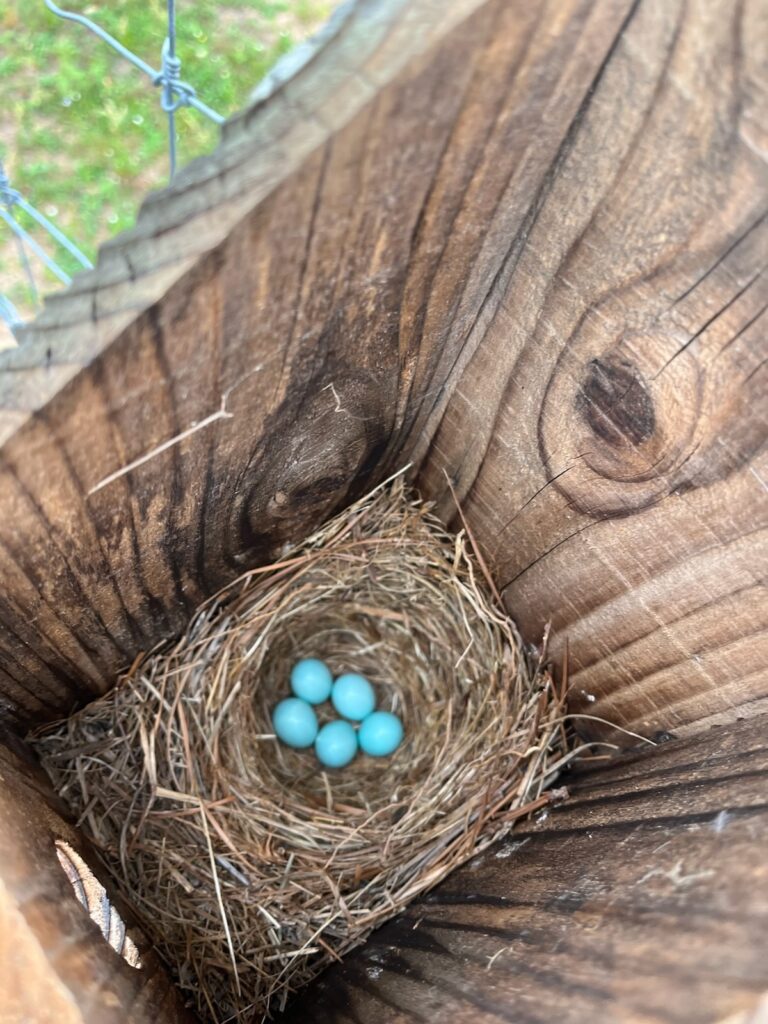
Bluebird eggs are a welcome herald of Spring at the Bluebonnet Master Gardener Association’s Sens Center Demonstration Garden.  Five lovely bluebird eggs are in a nest box attached at the top of an 8′ tall chain-link fence which encloses the garden.  The nest box faces west toward an open area with woods approximately 100′ away.  The Sens Center Demonstration Garden is located in Bellville, Texas behind the Sens Community Center.

There are several species of bluebirds found in Texas, including the Eastern Bluebird, Western Bluebird, and Mountain Bluebird. Eastern Bluebirds are the most common throughout the eastern and central parts of the state, while Western Bluebirds and Mountain Bluebirds are less common and typically found in the western and northern parts of the state. Bluebirds in Texas prefer open areas with scattered trees and may be found in fields, pastures, and orchards. They primarily feed on insects and berries and can often be spotted perched on fences, power lines, or other elevated perches. Bluebirds are a beautiful and welcome sight in Texas and are often attracted to birdhouses placed in suitable habitats.

Bluebird nest boxes are encouraged by Texas Parks & Wildlife Department (TPWD) as the boxes provide important habitat for bluebirds and other cavity-nesting birds. In many areas of Texas, natural cavities suitable for nesting are in short supply, so nest boxes can be a vital resource for bluebirds.

The photo was taken by certified Master Gardener and BMGA member Leah Pearce, on Wednesday, April 5, 2023.

Filed Under: BMGA Gardens Tagged With: Vegetables

2022 Scholarships Awarded

October 1, 2022 by cmschweikhardt

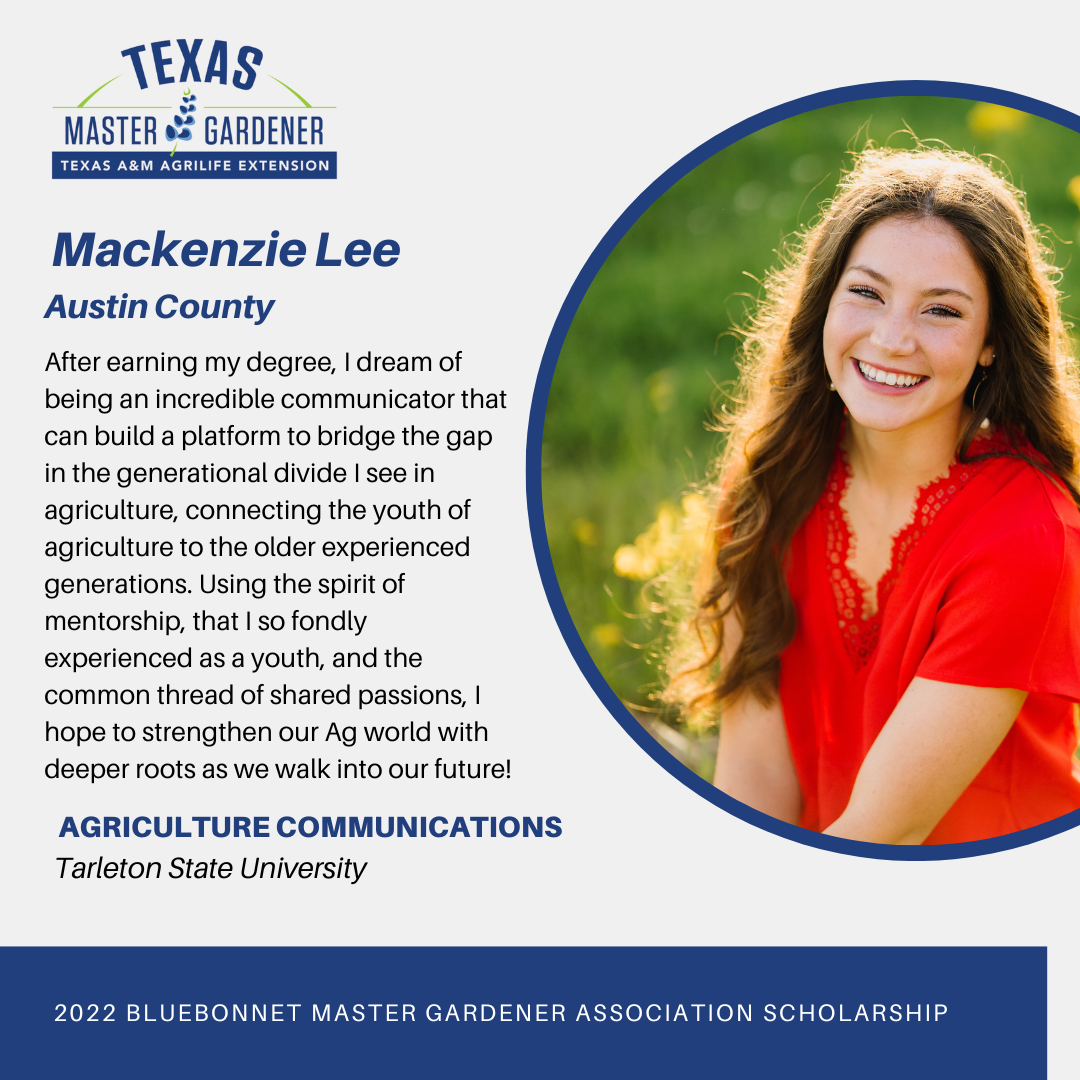
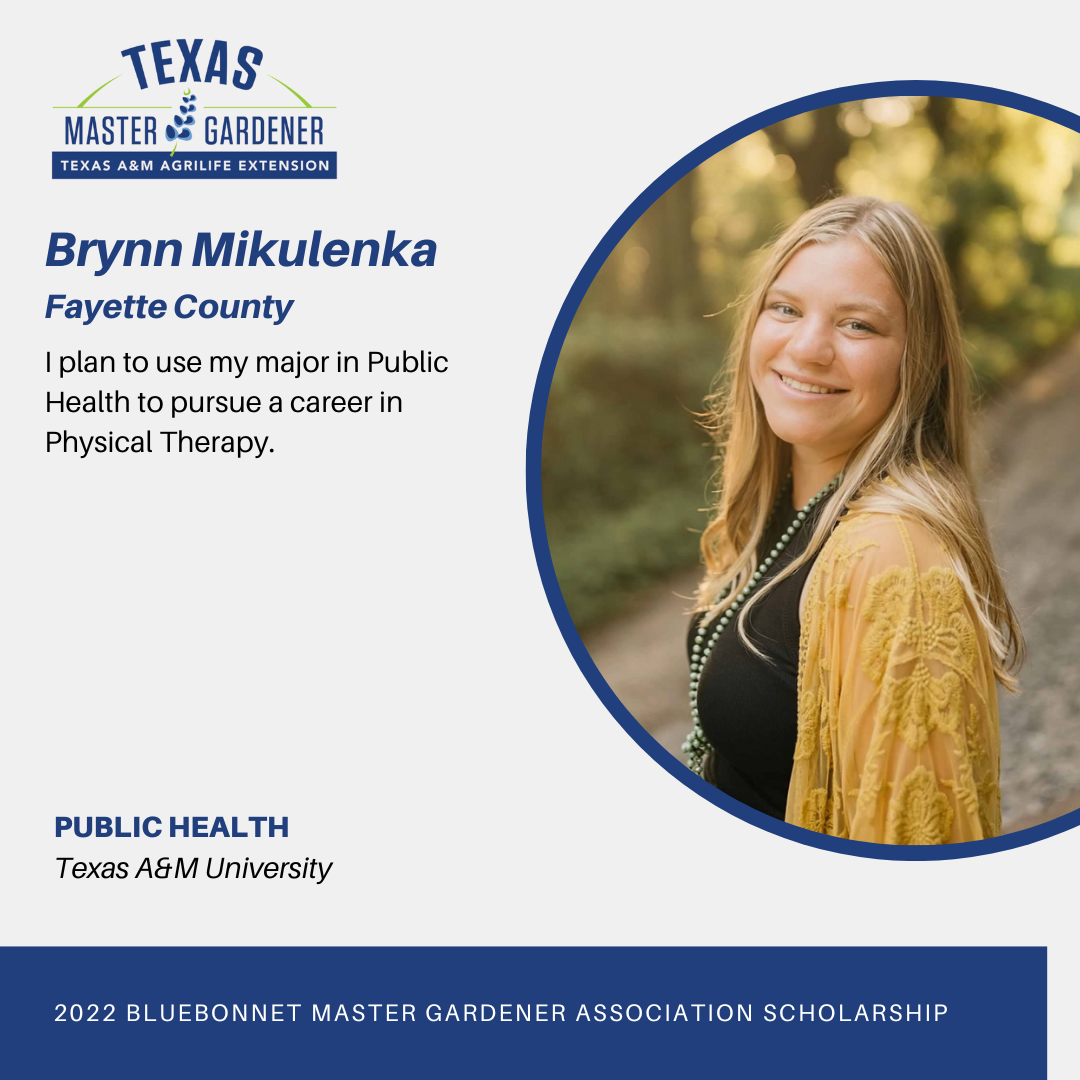
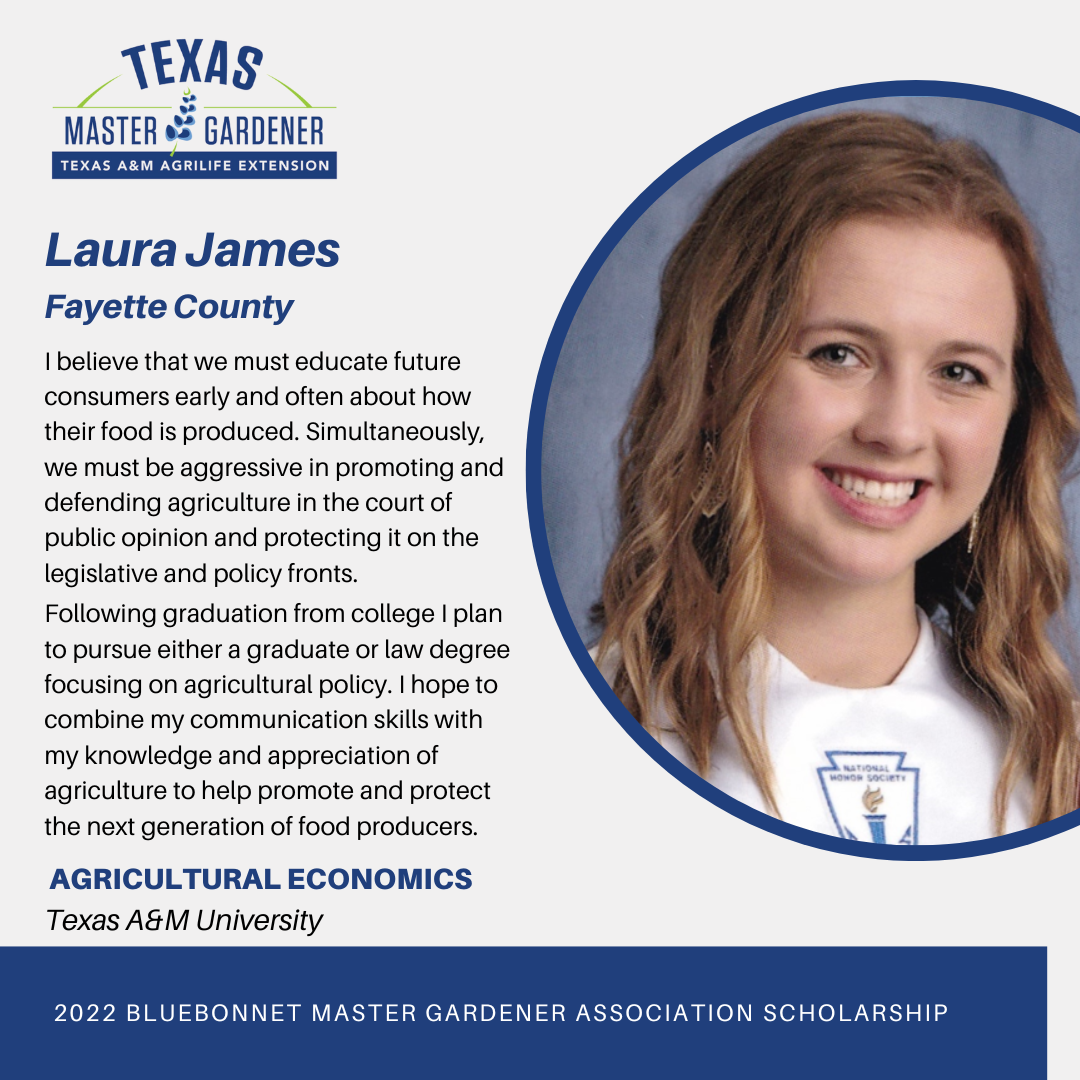
The Bluebonnet Master Gardener Association is proud to announce its 2022 annual college scholarships winners.  Eight scholarships, ranging from $1,500 to $1,000, were awarded to high school graduates from Austin, Washington, Fayette & Colorado Counties, Texas. To view the winners’ bios, see below.  The winners are:

Mackenzie Lee (Austin Co.)
Jagar, Rau (Colorado Co.)
Brynn Mikulenka (Fayette Co.)
Laura James (Fayette Co.)
Waylon Hinze (Washington Co.)
Weston Hinze (Washington Co.)
Keely Mikolajchak (Washington Co.)
Eli Saunders (Washington Co.)

All eight demonstrated outstanding acheivement in leadership, citizenship, community service and other endevours that form the basis of becoming lifelong responsible, productive citziens and leaders in their communtiies.

Congratulations to our 2022 scholarship winners!

Mackenzie Lee

Jagar Rau Brynn Mikulenka Laura James Waylon Hinze Westin Hinze Keely Mikolajchak Eli Saunders


Filed Under: Other

Intern Class of 2022 Graduates

May 10, 2022 by cmschweikhardt

By Faye Beery, 2022 Class Coordinator

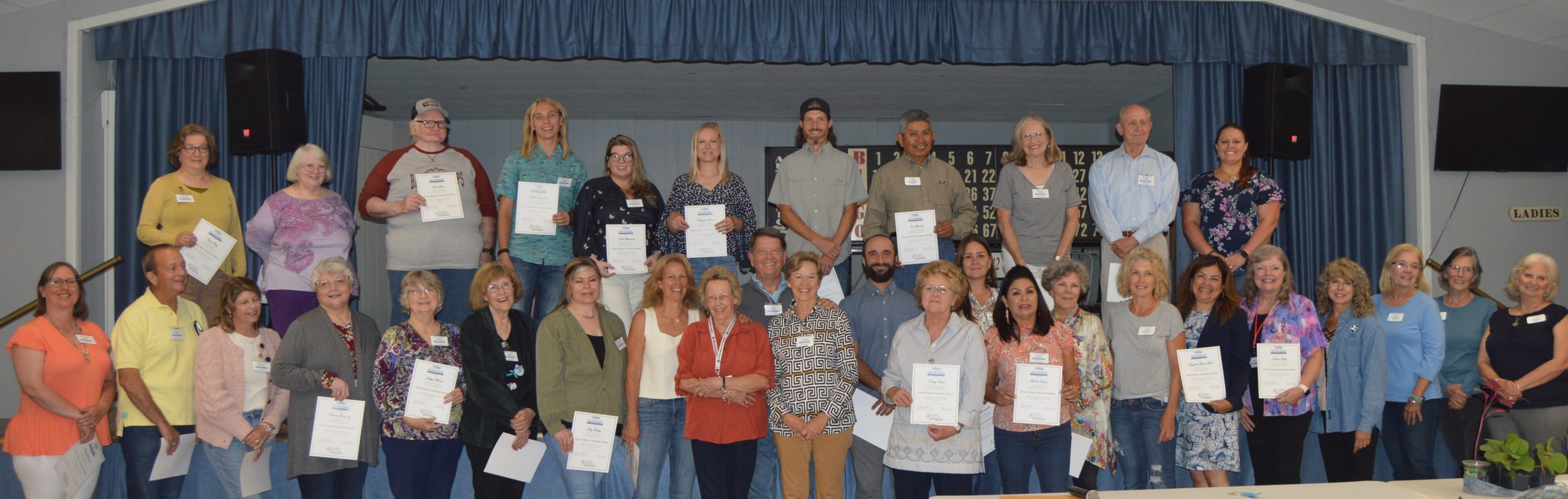
On April 26, 2022, our new Bluebonnet Master Gardener intern class graduated with 33 interns.  One of them, Joe Jimenez, completed his 50 hours of volunteer work during the class period and is now a full fledged Master Gardener.  We also had the youngest intern that we have had, Webb Sherman, age 17.  The class had the largest ever enrollment with 40 students, but unfortunately, we lost 7 due to various reasons.

Joe Jimenez

Joe Jimenez with Class Coodinator Faye Beery.

Webb Sherman

Webb Sherman with Class Coordinator Faye Beery.


We kept statistics for our class to determine the knowledge gained during the classes. Our pretest average grade was 55 with 23 missed. Our final test (posttest) averaged 89. The highest score was 98, made by several people. We also gave them 2 bonus questions from a list of words given them weekly that corresponded with their chapter. With the bonus questions, the average score was a 95. With the bonus questions, the highest score was a 108.

Several of the students were new to the area, having recently brought property in one of our 4 counties. There were also 3 sets of couples who were new to the area.

All of them were eager for information and asked lots of questions. They enjoyed the speakers and kept some of them a little over time to ask more questions. They are going to be good master gardeners, a good source of information for our community, and good friends.

Thanks also to the helpers for the class. Nikki Griffin was invaluable handling all the food and drink for the classes, as was Marcella Ausmus, helping with the hospitality and grading papers.  Esther Hartman, Susan Yancey, and Leah Pierce helped to grade papers also. Thanks to all who came.

2022 Intern Class

Bluebonnet Master Gardener Intern Class 2022

Interns:

Prudence Allwein
Ramin Baranpourian
Jim Campbell
Mary Lu Campbell
Nancy Darst
Linda Duffy
Carla Eriksson
Tory Farley
Jeri Franco
Dolores Gonzalez
Cheryl Grassmann
Freida Hale
Amy Schramm
Webb Sherman
John Sims
Chris Terry
Jim Hudgins
Linda Huron
Joe Jimenez
Chad Johnson
Kayleigh Johnson
Lorrie Maddox
Scott Maddox
Rebecca Marek
Margie O’Brien
Mary Ott
Karen Reip
Jacqueline Samples
Keri Sherman
Barbara Shersh
Carrie Staples
Renee Urish
Angelica Zurita


Filed Under: Education, Other Tagged With: CertificationClass

There’s Always Something Blooming

December 2, 2021 by cmschweikhardt

There’s always something blooming in our native plants garden. Low maintenance and lots of color even in the fall. Texas Lantana, Scarlet Sage, Green-Eyed Daisies, Mealy Blue Sage and Esperanza are still showing off their beautiful flowers. The Chile Pequins are full of peppers and the Yaupon Holly is loaded with beautiful red berries. The garden is open to the public so stop by and see what’s blooming.

Common Name: Lantana
Botantical Name: Lantana urlicoides


This Bluebonnet Master Gardener Association Texas Natives Garden is designed to educate visitors, students and area residents as to the benefits of native plants. The garden shows how native plants, trees and grasses attract bees, butterflies, and birds as well as providing a beautiful display of seasonal color.  Water-wise gardening practices are on display as an educational tool to show how rainwater harvesting and a drip irrigation system can be used efficiently.

Link to more information about Lantana urliocides

Find the garden located at:

E.A. Arnim Archives & Museum
101 E. North Main Street
Flatonia, TX 78941
The garden is between the brick and metal buildings on Hwy 95.


Filed Under: BMGA Gardens Tagged With: Pollinators, TexasSuperstars, Wildflowers

Pete & Paula’s Pollinator Patch

August 18, 2021 by cmschweikhardt

Photo of Pete & Paula's Patch

Photo of Pete & Paula’s Patch

Pete & Paula’s Pollinator Patch is a section of the Bluebonnet Master Gardener’s Sens Center Demonstration Garden in Austin County, Texas.  The garden overall is dedicated to demonstrating sound techniques for growing vegetable and other food crops.  However, this year, Master Gardeners Pete Smith and Paula Trahan started the “Pete & Paula’s Pollinator Patch” to demonstrate the use of plants which attract pollinators to the garden to pollinate the vegetables in the garden. As many fruit and vegetable plants require a pollinator to set fruit, attracting pollinators to the garden is necessary.

Photo of lantana

Lantana

After about four months, Pete and Paula are pleased with how quickly our pollinator garden has progressed. “We truly got a late start, but everything has grown by leaps and bounds. Every plant was a pass along or freebie from the garden center.” Ms. Trahan explained.  Pete & Paul’s next step is to include a small solar water feature in the center to attract more butterflies, bees and birds. Included in the garden are lantana, standing cypress, Asian purple basil, echinacea, porterweed, rock rose mallow.

Filed Under: BMGA Gardens, Other Tagged With: Pollinators, Vegetables

Twenty Years and….Counting! (& the Keyhole Garden)

June 4, 2021 by cmschweikhardt

By Faye Beery, Bluebonnet Master Gardener Assocaiton

That is how long the Master Gardener program has been going in our 4 county region.  On May 25, 2021 the Bluebonnet Master Gardeners celebrated our 20th anniversary of the demonstration garden in Austin County. While the weather was not the best, everyone enjoyed the program given by Dr. Shackelford, good food and seeing the Bluebonnet Master Gardener Association’s demonstration garden located at the Sens Acitvity Center in Bellville, Texas. Vegetables were available, most gave a voluntary donation to the garden,  as well as some produce was avaialbe to pick in the garden.

Pete Smith standing the in the “keyhole” of the keyhole garden

A big attraction in the garden was the keyhole garden. The keyhole concept was first introduced into arid African regions by the U.K. organization Send a Cow. The idea was to help poor families grow their own food despite the poor soil and drought conditions. The keyhole concept is a raised circular bed with a wedge shaped cutout on one side which allows persons easy access to the whole bed. When seen from above, it resembles a lock and keyhole. In the center is a wire cage for compost which decomposes and provides nutrients to the bed.  This form is less labor intensive and more affordable for people who want to grow their own food. And you don’t have to bend over.

The outer structure can be any sturdy material, cinder blocks, bricks, rocks are a good choice. They are placed in a round design with a wedge on one side so that individuals can reach the middle as well as the outsides allowing for easy planting and harvesting. The wire cage in the center makes it easily accessible to place the compost materials.

Building the keyhole

Keyhole garden constuction

building the keyhole garden

Keyhole garden under construction


Rainwater system & keyhole garden

Rainwater system & keyhole garden

A strong advocate of the keyhole concept is Deb Tolman, PhD, from Clifton, Texas. She is an environmental scientist and landscape designer and co-founder of the Silo Project a non-profit organization, which is centered on sustainability. Due to her outreach and workshops, there are more than 70 keyhole gardens in Clifton, which is in arid North Texas.  She recommends a 3:1 ratio of brown and green material which forms the core garden. Decomposition rapidly generates heat and breaks down the material to feed plants. Brown material includes brown grass/leaves; paper and wood, straw, sawdust, lint from the dryer or vacuum, and lots of cardboard, which is the first layer in the bottom of the bed. It should be thoroughly wet to begin decomposition. Green materials include kitchen scraps, manure, green grass/leaves, or plants. Her website provides instructions on how to construct a keyhole garden.  Follow the link to her  Field Guide PDF .

There is also a new addition to the garden which is currently under construction this week. It is Pete and Paula’s pollinator patch. They plan to include plants which attract pollinators to the garden to pollinate the vegetables that grow there. We’ll have more on this when they begin planting.

I know everyone is happy to get back to our regular meetings. See you at the next one!

Filed Under: BMGA Gardens Tagged With: Compost, Irrigation, Pollinators, RainwaterHarvesting, Vegetables

2021 BMGA College Scholarships Announced

May 26, 2021 by cmschweikhardt

The Bluebonnet Master Gardener Association is proud to announce its 2021 annual college scholarships winners.  Three $1000 scholarships were awarded to high school graduates from Washington, Fayette & Colorado Counties, Texas.  The winners are Taylor Limbaugh (Fayette County),  Clayton Boeker (Washington County) and  Leroy Stavinoha, III (Colorado County).   All three demonstrated outstanding acheivement in leadership, citizenship, community service and other endevours that form the basis of becoming lifelong responsible, productive citziens and leaders in their communtiies.

Congratulations to all three 2021 scholarship winners!

Taylor Limbaugh, Fayette County

Clayton Boeker, Washington CountyLeory Stavinoha, III, Colorado County

Filed Under: Other Tagged With: Kids

2021 Master Gardener Training Class Graduates New Interns

May 17, 2021 by cmschweikhardt

2021 Intern Class

The Bluebonnet Master Gardener Association is proud to announce the graduation of 10 Master Gardener Interns who completed its 2021 Master Gardener Training Class.  The training classes began January 12th and continued every Tuesday through April 27th at the Weimar Civic Center.  This was the first Master Gardening Training class held in Colorado County, although trainees from all four BMGA counties were eligible for the class.  The 2021 Class Coordinator was BMGA member Robbie Showers, who was assisted by Lynn Showers.  Colorado County AgriLife Extension Agent Laramie Kettler was the sponsor of the class. Some training presentations were virtual while some where in-person.

After completing 64 hours of intense instruction and passing a final exam, to be certified as a Master Gardener,  the interns are required to complete 50 hours of gardening volunteer service within 1-year.  Such volunteer activities must be work on approved BMGA projects that assist Texas A&M AgriLife Extension Service in educating the public about gardening.

One of the ten interns, Ms. Nancy Galloway, completed her 50-volunteer hour requirement prior to the class graduation date in April.  Robbie Showers commented that the 2021 “interns are eager to learn and work hard to get their hours.”  She said they “were a great bunch of people to work with” during the class.

Congratulations to the 2021 BMGA Master Gardener intern graduates:

Cheryl Rose
Mariar Schonenberg
Frank Montieth
Norma White
Nancy Galloway
Regena Williamson
Mary Ellen Holub
Lisa Slinkard
Linda Miller
Sharon Wegenhoft.

Filed Under: Other Tagged With: CertificationClass

Bugs by the Yard & Unwanted Guests Podcasts

May 1, 2021 by cmschweikhardt

Bumble Bee Insects and pests are some of the most diffcult challenges home gardeners and homeowners try to manage.  To address these issues, Texas A&M AgriLife Extension Service specialists in entomology and integrated pest managemnt (IPM) have team-up to present two podcasts:  “Bugs by the Yard”  and “Unwanted Guests”.  Both are free and open to the public to listen and learn from these specialists.

Bugs in the Yard: A weekly podcast focused on garden pests and bugs.

Hosts: Texas A&M AgriLife Exention
Dr. Erfan Vafaie (IPM Specialist)
Molly Keck (entomologist, Bexar County)
Wizzie Brown (entomolgoist, Travis County)

Listen:   
Link to Listen to Bugs by the Yard Podcasts


Unwanted Guests: This podcast covers insects and pests we don’t want in the house.

Hosts: Texas A&M AgriLife Exention
Robert Puckett, Ph.D. (entomolgist, Bryan-College Station)
Jane Hurley (IPM Specialist, Dallas)
Molly Keck (entomologist, Bexar County)
Wizzie Brown (entomolgoist, Travis County)

Listen: Availalbe on podcast platforms like iTunes and Audible.


Filed Under: Other Tagged With: CEU, Pests

Black Soldier Fly – A Quick and Easy Method for Composting

April 20, 2021 by cmschweikhardt

The black soldier fly has a unique life-history and are quickly gaining global attentionf or their ability to convert organic waste into valuabe protein and rich fertilizer.  This Texas A&M AgriLife Extension online workshop will highlight rearing methods of the black soldier fly application to everyone from backyard hobbiests to the scale of industrialized production. 

What:  Black soldier Fly – A Quick and Easy Method for Composting
When: May 28, 2021 from 8:00 a.m. – 12:00 noon
How: Via Zoom link Launch Meeting – Zoom

Blck Soldier Fly

Filed Under: Other

Lightning Damage on Live Oak Tree

April 13, 2021 by cmschweikhardt

Lightning damage on oak tree

Bark blown off the “Lightning Tree” by lightning strike.

Lightning is a grand display of nature’s power.

Strong thunderstorms rolled through our area in March 2021.  Afterwards, we suspected one of the mature live oak trees on our property was hit by lightning.  I sent some photos of the tree to Daniel Lewis of the Texas A&M Forest Service. Mr. Lewis confirmed the photos showed a textbook pattern of a lightning strike.  He also assured that most trees recover from lightning strike damage with no problem.

About 30,000,000 cloud-to-ground lightning strikes hit in the contiguous 48-states of the United States every year. Although lightning does not always strike the highest point around, it usually does so, according to NOAA’s  National Severe Storms Laboratory.  This makes tall trees, particularly on a hilltop or in a pasture, more vulnerable to lightning strikes.

NOAA’s NSSL says a typical lightning flash is about 300 million Volts and about 30,000 Amps. In comparison, household current is 120 Volts and 15 Amps. There is enough energy in a typical flash of lightning to light a 100-watt incandescent light bulb for about three months.  Lightning heats the surrounding air anywhere from 18,000 degrees Fahrenheit to up to 60,000 degrees Fahrenheit.

Lightning damage on tree

Lightning damage wrapped around the tree.

Lightning traveling down a tree trunk turns water to steam. If it gets under the bark into the surface moisture of the wood, the rapidly expanding steam blasts pieces of bark and branches from the tree, and the wood along the path is often killed. The charge carried by the lightning is then dissipated along the surface of the Earth.  This is explained on the NSSL website Severe Weather 101. The photos in this blog show the blasted pieces of bark from our live oak tree.

There are ways to protect trees of significance or that could endanger human life if struck by lightning.  For more information go to Texas AgriLife Extension Tree Care Kit, Understanding Lightning & Associated Tree Damage.

One conclusion from the study of our lightning-struck tree (we now refer to it as the “Lightning Tree”) is that a mature Texas live oak tree, even jolted by the immense power of a lightning bolt, is mighty indeed.

By Christy Schweikahrdt

Filed Under: Other Tagged With: Trees

Plant Picturepages by Aggie Horticulture

February 28, 2021 by cmschweikhardt

LogoSometimes, the answer is just knowing where to look;  and someitimes, a picutre is just what you need to answer the question.   With the help of many collaborators, Aggie Horticulture assembled a few theme-oriented searchable databases for use in their classes and for the public to use and enjoy.  If you have not checked out Aggie Horticulture’s Plant Picturepages, the link is below.  Find the information you need in pictures or just enjoy the many horticulature related sites and photos.

Plant Picturepages

Filed Under: Education Tagged With: Fruit, Greenhouses, LandscapeDesign, Pollinators, Vegetables, Wildflowers

Frozen Plants? Aggie Horticulture Facebook Live Events

February 23, 2021 by cmschweikhardt

Logo

Texas A&M  Extension Horticulture faculty are using their weekly Facebook live events and one additional event to talk about the freeze and what to expect with plants. The schedule will be as follows:

Wednesday 1:00 p.m. Ornamentals & Vegetables

Friday 1:00 p.m. Fruit

Friday 4:00 p.m. Turf

These events can be found on Facebook on the Aggie Horticulture page and will be useful information for Master Gardeners and the public.  All events are free and open to the public.

Filed Under: Other Tagged With: CEU, Fruit, Lawns, Vegetables

Protecting Landscapes & Horticulture Crops from Frosts & Freezes

February 12, 2021 by cmschweikhardt

As temperatures drop below freezing in our area, gardeners may need to take action to protect their plants and landscapes.  Luckily, Texas A&M AgriLife Extension’s Monte Nesbitt and Robert “Skip” Richter give advice on protecting landscapes and horticultural crops from frosts and freezes.  For the full version of this paper (9 pages) please click this link:  Protecting Landscapes and Horticulture Crops from Frosts and Freezes

protecting horticultural crops from freezes

Filed Under: Education Tagged With: Vegetables

You Make a Life by What You Give

February 5, 2021 by cmschweikhardt

“The meaning of life is to find your gift. The purpose of life is to give it away.” — William Shakespeare

Texas Master Gardener Logo

Master Gardeners have a gift.  The purpose of our organization is to give that gift to others by teaching them about gardening.

What do Ernest Hemingway, Benjamin Franklin & Agatha Christie have in common?  They were all volunteers during hard times!  Hemingway was a volunteer ambulance driver for the Red Cross in Italy during World War I.  Benjamin Franklin was a member of a voluntary fire brigade in Philadelphia.  Agatha Christie was a volunteer nurse during World War I.

The year 2020 was full of hard times for so many in serious tragic ways.  Volunteerism overall dropped and many chartable and non-profit organizations struggled to carry out their non-profit and charitable purpose in 2020 and continue to struggle in 2021.  Some ask:  Can a little Master Gardener organization make a difference now, especially since our meetings are on online and so volunteers and members of the public must avoid gatherings?

The answer is yes! Master Gardeners can, and are, making a difference.  In 2020, scores of Americans, many who never put their hands in the dirt to plant a seed before, decided to try gardening to secure a healthier and reliable food source for their family.  Some, with “cabin fever” during stay-at-home order times, found gardening as a way to get outdoors and relieve anxiety.  Unfortunately, many of these gardens failed due to a lack of knowledge about the basics of soil preparation, the varieties to plant, how to irrigate, fertilization, pests, and other problems.  Many abandoned their pandemic Victory Garden, but others will stick with it.  Master Gardeners, even if for now volunteering online or in small groups outdoors, can assist these new gardeners and help turn them into passionate gardeners.

We can do this with sponsoring online education, plant and tree sales with planting and care advice, and planning for the future.  Planning for when we can work with kids in school gardens, operate our popular summer Kids Kamp and all get together again for other activities.  But these things, like plants in the garden, need tending now if we want them to grow and be beautiful in the future.

Charelen Koehler teaching class

Charlene volunteer teaching at Sealy High School

It is important to recognize volunteers for their selfless hard work.  However, volunteering is about more than logging hours worked, certificates of achievement or accolades.  As an example, Bluebonnet Master Gardener Association members Charlene and B.R. Koehler exemplify the true volunteer spirit.  In 2020, despite the pandemic and her own personal challenges, Charlene logged 350 volunteer hours for BMGA, and those are just the hours she took the time to enter into the system!  Charlene and B.R. also volunteer long hours with other organizations giving of themselves to their community in multiple ways. When asked why she and B.R. volunteer, Charlene said, “Volunteering is all about sharing one’s time and talents.  It is an opportunity to learn and work alongside like-minded people who share the same interests and goals.  B.R. and I believe in helping others, our community and ourselves by learning and passing on the knowledge to others.”  That is the true spirit and heart of a volunteer.

Without volunteers, many educational, health care and humanitarian needs would go unfulfilled.  Volunteers make a positive difference in the lives of others.

Did you know that altruistic volunteerism also provides important benefits to the volunteer?  Researchers know that volunteering benefits the volunteer by boosting the volunteer’s positive feeling, known as the “Helpers High.”  According to the Mayo Clinic website, research shows that volunteering offers health benefits, especially for older adults, such as:

  1. Volunteering decreases the risk of depression.
  2. Volunteering gives a sense of purpose and teaches valuable skills.
  3. Volunteering helps people stay physically and mentally active.
  4. Volunteering may reduce stress levels.
  5. Volunteering may help you live longer.
  6. Volunteering helps you meet others and develop new relationships.

According to Harvard Health Blog (citing Health Psychology of the American Psychological Association) psychologists “found that participants who volunteered with some regularity lived longer, but only if their intentions were truly altruistic. In other words, they had to be volunteering to help others—not to make themselves feel better.”

In 2021, Bluebonnet Master Gardeners can make a difference in their communities by volunteering and, perhaps, live longer and healthier for it.

“You make a living by what you get. You make a life by what you give.”
—Winston Churchill.

Filed Under: Education, Other

Frost/Freeze Protection in Small Raised Beds

January 13, 2021 by cmschweikhardt

By Paula K. Trahan, BMGA Master Gardener

As our Texas fall has turned into a real winter including snow in Bluebonnet Master Gardener’s four counties, we are all seeking to protect our precious plants we put into the soil in September and October.  Depending on the size of garden you have, there are options to shield your investment and not lose much, if any, plant stock.

In past seasons, I have not been vigilant in covering my small, raised beds and just taken my chances.  This stance has cost money (losing future production and plant material) as well as extra work (all the wilted plants are a mess!).   Social distancing has given me time to design a frost/freeze protection system that can be deployed easily and removed for use this year and next.  With an up-front cash outlay of less than $100.00, the coverage is approximately 160 sf (two raised beds, 4×20 feet each).

The structure consists of several 1/2” pvc pipes, 10’ long.  Each pipe is bent in an arch across the raised bed and tucked inside along the raised portion of the bed’s 2×10’s.  The interval is about 4’ apart. With a bed width of 4’, this arch is around 4’ high giving plenty of height for your growing plants. As the bones of the system doesn’t interfere with the garden itself, you can leave these in place until the danger of frost is gone in spring.

Planket installed over raised bed for the recent freeze in Cat Spring, Austin County.

Planket installed over raised bed for the recent freeze in Cat Spring, Austin County.


The product to cover and protect was readily available at a local do it yourself store.  The brand purchased was Planket.  It comes in various sizes and variations such as round and rectangular.  The application for my garden needed 2 packages of 10×20’.  These were cut in half resulting in four 5×20’ pieces. This was easier for one person to handle when installing, especially on a windy day.  Each piece was laid lengthwise across the skeleton of pvc pipes then clipped together with colorful binder clips and then attached to the pipes themselves with small plastic clamps.


Clips holding the fabric on to the pvc skeleton.

Clips holding the fabric on to the pvc skeleton.

The clamps are perfectly sized, and the fabric doesn’t blow apart or in the case of recent sleet and frozen precipitation, it won’t sag and touch the plant material inside.

With our unpredictable weather it may be necessary to remove after only one or two days.  It is quite simple to take the Planket off and store for the next frost warning.  Just unclip all the fabric, lay it out lengthwise on the grass and roll each piece onto the cardboard tubes in which they were purchased.  Rolling them at a two-foot width allows for storage in a plastic tub along with the binder clips and clamps.  Plus, storing them in a roll makes for trouble free use in the future.


After several hours of freezing weather, the brussel sprout leaves are unfazed. Very easy to check on the status of your plants by just unclipping at various places.

After several hours of freezing weather, the brussel sprout leaves are unfazed. Very easy to check on the status of your plants by just unclipping at various places.

Brussel sprouts looking good. Ready to harvest soon.

Brussel sprouts looking good. Ready to harvest soon.


Broccoli plants are still producing from side shoots, so we are protecting them.

Broccoli plants are still producing from side shoots, so we are protecting them.

As it is early January, you can still get a couple of months use out of a system such as this.  Considering the cost of plant loss and replanting, it can still be cost efficient for your garden. We all remember those late Easter freezes and now you won’t be caught off guard! For more information on larger garden frost protection, please consult your local BMGA Master Gardener.

Filed Under: BMGA Gardens, Other Tagged With: Vegetables

Online Horticulture Learning Could Never be Easier

November 20, 2020 by cmschweikhardt


LogoSo many online horticulture learning opportunities you don’t know where to start?  This guide can get you started learning from horticulture experts.

Texas A&M AgriLife Extension recorded many of their programs for viewing on your own schedule.  These recorded presentations are free to the public.

Bluebonnet Master Gardener Association members may claim Continuing Education Units (CEU) for these all AgriLife programs that pertain to gardening and horticulture; live or recorded.  Just watch the presentation and record your time as CEU.  BMGA members, remember to get your CEU credits recorded by December 31, 2020 to apply those hours to your re-certification requirement.  For 2020, you need 6 CEU credits.

Below are links to some of these programs to start learning from our Aggie experts.

Gulf Coast Gardening Online Series
There are 22 videos for more than 24 hours of learning. Topics include:

Young Tree Care – Video  #5
Earth Kind Pest Disease & Weed Control – Video #10
Texas Superstar Plants – Video #19

Horticulture & Gardening Webinar Series with David Rodriguez, County Extension Horticulture Agent, Bexar County
There are currently 17 of these recorded sessions for more than 13 hours of education. Topics include:

Getting Your Lawn and Landscape Ready for Summer Heat – Video #9
Tomato Basics 101 – Video #13
Butterfly Gardening – Nectar Plants – Video #5

Aggie Horticulture Facebook Live Recordings
There are 55 horticulture recorded events. Wow!  You do not need a Facebook account to watch.  Topics include:

Homeowner Greenhouses- Video #41
Transitioning to a Fall Garden, Two Parts – Video #40 & #45
Toys for Vegetable Gardening – Video #50
Fall Blooming Flowers & Biennials Planted in Fall – Video #51
Growing Blueberries in Containers – Video 18


Filed Under: Education Tagged With: CEU, Disease, Earth-Kind, Fruit, Greenhouses, Herbs, Lawns, Pests, Seminar, TexasSuperstars, Trees, Vegetables

Mystery seeds arrive in Texas

July 29, 2020 by cmschweikhardt

Texas AgriLife Today reports that mystery seeds have arrived in Texas. Texas residents are now among those across the nation receiving mysterious seeds delivered by mail in tiny bags marked as jewelry. U.S. Department of Agriculture officials are on alert because these seeds are unsolicited.

Several local BMGA members report receiving these seed packages.

Kevin Ong, Ph.D., Texas A&M AgriLife Extension Service plant pathologist and director of the Texas Plant Disease Diagnostic Laboratory in College Station, said the concern arises because these packages have seeds in them instead of what is listed, and there is no information on what type of seeds are in packages.  Dr. Ong told AgriLife Today: “We don’t know what kind of seeds they are,” Ong said. “Not knowing what the seeds are could potentially open our agriculture industry up to noxious weeds. If that proves to be the case, if they take hold, they could impact agriculture negatively.”

The public is advised not to plant the seeds and not to just throw them away until experts determine more about the seeds.

All incidences of receipt of these unrequested seeds should be reported to USDA-APHIS by sending an email to Carol Motloch, USDA-APHIS’ Texas PPQ state operations coordinator, at [email protected]. The email should include a contact email and phone number as well as a description of package information. Sending a photo of the label and material would also be helpful.

For more information, please see the full AgriLife Today article.

Filed Under: Other

2020 BMGA Scholarship Awards

July 28, 2020 by cmschweikhardt

The Bluebonnet Master Gardener Association is proud to announce its annual college scholarships winners.  Three $1000 scholarships were awarded today to high school graduates from Washington, Fayette & Colorado Counties, Texas.  The winners are Braylee Schomburg (Washington County), Megan Schultz (Fayette County) and Zane Wanjura (Colorado County). Each recipient attended the BMGA July 28,  2020 online video conference meeting to introduce themselves to the entire membership.  The bright students received some words of wisdom from some of the Master Gardeners and fielded questions from the audience.   Read more about them below or click this link:  Scholarship Winner Bios.  

Congratulations to all three winners!


Breylee's Note


Zane's Thank You Note


Filed Under: Education, Other

Backyard Bug Hunt Recorded Series

July 27, 2020 by cmschweikhardt

If you missed Wizzie Brown’s Backyard Bug Hunt webinars, below are links to recorded series to date.

Ms. Brown is an Integrated Pest Management Program Specialist in Travis County.  She earned a Bachelor of Science degree in Entomology from the The Ohio State University in 1996 and her Masters in Entomology at Texas A&M University in 1999.

When you find insects in your garden, your first instinct might be to destroy them, but that’s not always the best action.  Of the 1.5 million known insect species in the world, more than 97% are beneficial to gardens, or simply benign.  That leaves less than 3% that are agricultural and nuisance pests.

Bluebonnet Master Gardeners may claim CEU credit for these live or recorded events.

You may watch these webinars on the Travis County AgriLife Extension site or click the topics below:

Butterfly & caterpillar ID (Nymphalids & Papilionids)

Attracting insects to your yard

Veggie pests

Spiders

Fire ant biology & management

All about ants- ID & biology

Mosquitoes

Fly identification & management

Stinging & biting arthropods


Filed Under: Other Tagged With: CEU, Pests, Pollinators

Texas Blue Bells-Eustoma exaltum russellianum

July 24, 2020 by cmschweikhardt

Many thanks to Dr. William C. Welch for sharing his article with the Master Gardeners.

Below are a few additional photos from BMGA member Christy Schweikhardt’s pasture in July 2020.  These blue bells were not mowed down and will hopefully re-seed for next year.

Blue Bells in Christy Schweikhardt’s pasture, Washington County, Texas

White Blue Bells in Christy Schweikhardt’s pasture in Washington County, Texas

Blue Bells, Washington County, Texas

Filed Under: Other

  • Page 1
  • Page 2
  • Go to Next Page »

Quick Search Tags

Advanced Training CertificationClass CEU Citrus Compost Disease Earth-Kind Fruit Fruit Trees Greenhouses Herbs Irrigation Kids LandscapeDesign Lawns Lunch N Learn Pecan Trees Pests Pollinators Propagation RainwaterHarvesting Seminar Soil Testing Succulents TexasSuperstars Tomatoes Trees Vegetables Volunteer Webinar Wildflowers
Texas A&M AgriLife Extension Service
Texas A&M University System Member
  • Compact with Texans
  • Privacy and Security
  • Accessibility Policy
  • State Link Policy
  • Statewide Search
  • Veterans Benefits
  • Military Families
  • Risk, Fraud & Misconduct Hotline
  • Texas Homeland Security
  • Texas Veterans Portal
  • Equal Opportunity
  • Open Records/Public Information