Join the Somervell Master Gardeners for our last program of the year, Native Gardens for Pollinators! Monday, October 24, 2022, 6:30pm at the Somervell County Citizens Center, 209 SW Barnard. Our own Master Gardener, Tessa Ownbey will be describing the native plants and other features needed for creating your own pollinator garden. Learn how to attract all sorts of butterflies, bees and other creatures for a sustainable and interesting landscape!
Tessa is an 18 year certified Master Naturalist, a long time Master Gardener and Master Composter and is NPSOT certified in Landscape Maintenance. Tessa recently retired from Fossil Rim Wildlife Center as Director of Education and now spends her time with her husband on their 17 acres in Bosque County, which they have dedicated to wildscaping for insects, songbirds and neo-tropicals, and as a refuge for their 6 children and 13 grandchildren.
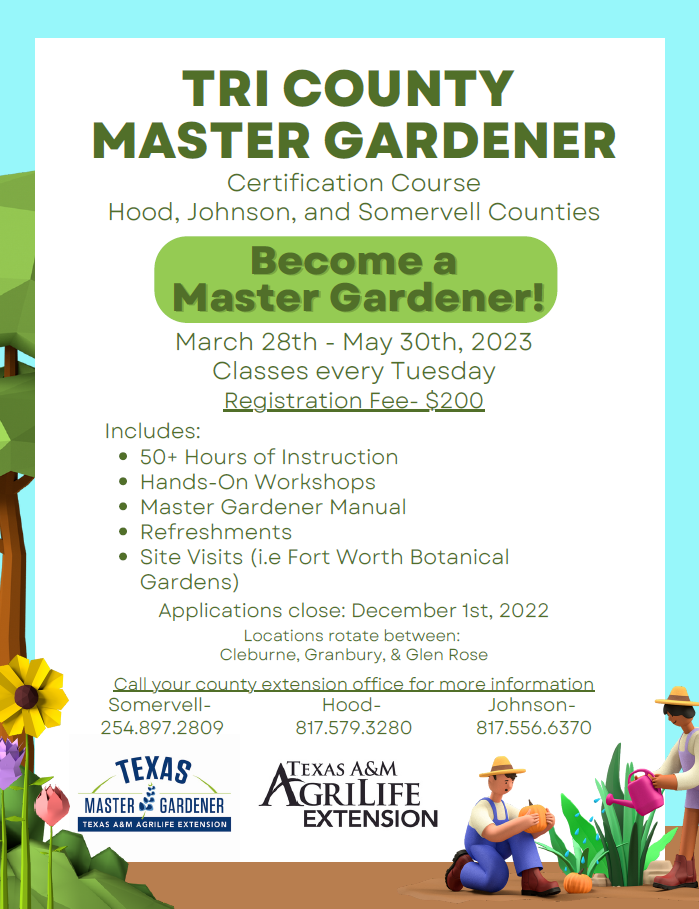
2023 Master Gardener Training
Astronomical Events that Affect Our Environment
We’ve all heard of people who really do plant or harvest their gardens by the moon or stars! Join the Somervell County Master Gardeners on Monday, September 12, 6:30 pm at the Somervell County Citizens Center, 209 SW Barnard, Glen Rose, to hear Robert Slaughter discuss just how astronomical events can and do play a part in our environment!
 The Universe and the Earth’s Natural Environment. How do events that occur millions, even billions of miles from the Earth affect our environment? Does the Earth itself affect our natural world? In this presentation, Robert Slaughter will delve into the processes that can change the world we live in, from the Sun, to the Moon, to highly energetic events that occur billions of miles from the Earth. We will look at these and other processes that affect the world we live in.
Reminder! Fall Gardening Preparation Program
It’s almost time!
With the recent tantalizing bits of rain, gardeners can be more optimistic that maybe we can be successful with our fall gardening endeavors! Fall gardening…ah, yes, it really is time to start getting things ready and possibly even in the ground! Come to the Somervell Master Gardener’s Community Horticulture Education program, Fall Gardening Preparation and hear Harold Annis, Tarrant County Master Gardener tell us everything you need to know to give your fall gardens the best chance for success!
August 15, 2022, at 6:30pm at the Somervell County Citizens Center, 209 SW Barnard, Glen Rose, TX
More details…
 Yes, even with this oppressive heat, we gardeners are ever hopeful! And oddly, now is a good time to get serious about planning and preparing for our fall gardens! Harold Annis, Tarrant County Master Gardener will be presenting a program on just that! Fall Gardening…Fall is a great time to grow vegetables: many of the bugs have gone away and the outside temperature is (hopefully) bearable to humans.
During the class we will discuss the essential elements of vegetable gardening; Site, Sun, Seed, Soil and Season. Harold will give special emphasis to fall gardening with suggestions on how to be more successful and enjoy fall gardening.
“To plant a garden is to believe in tomorrow”….Audrey Hepburn
Fall Gardening Prep Program
Mark your calendars for our Fall Gardening Preparation program!
August 15, 2022, at 6:30pm at the Somervell County Citizens Center, 209 SW Barnard, Glen Rose, TX
Yes, even with this oppressive heat, we gardeners are ever hopeful! And oddly, now is a good time to get serious about planning and preparing for our fall gardens! Harold Annis, Tarrant County Master Gardener will be presenting a program on just that! Fall Gardening…Fall is a great time to grow vegetables: many of the bugs have gone away and the outside temperature is (hopefully) bearable to humans.
During the class we will discuss the essential elements of vegetable gardening; Site, Sun, Seed, Soil and Season. Harold will give special emphasis to fall gardening with suggestions on how to be more successful and enjoy fall gardening.
“To plant a garden is to believe in tomorrow”….Audrey Hepburn
Mapping Your Sun Path
by Valerie Freund
One important component of successful gardening is knowing how much sun or shade each area of your garden receives throughout the day. For instance, you may want to build a new bed in an area you have not planted before. Because it is new you have probably not paid much attention to the amount of sun that area receives. Or maybe you have a plant that is struggling and needs to be moved to an area that has the proper exposure. For these and other scenarios I refer to the map of my SunPath. This map is a valuable reference tool that I have used for many years.
 Every year, by May 21st until mid-August, as the sun moves east to west each day, its path is about as far north as it will get in our hemisphere. Obviously, this is the hottest time of year in Texas and therefore the most crucial time to know where the sun falls on your property. A Sun Path map will limit mistakes when purchasing plant material and show you where to place your plants so they will be happy and thrive.
Would you like to know where you can get this nifty tool? It can’t be purchased but you can create your own personal Sun Path map. It is easy to do with a small expenditure of your time and little to no cost. Best of all, once you have completed the map you never have to do it again. If things change, a tree dies, a fence is built, etc. you can easily update your original Sun Path map.
You might be thinking, “Why bother with a map? All I need to do is look outside to see where it is sunny.” However, for most gardeners the exposure changes in any given area of their property throughout the day. Sometimes those changes are dramatic. Even if you have lived in your home for years you are still just making an educated guess without a map of your Sun Path.
By mapping your Sun Path you will find out exactly how much sun and shade you have, what type and where it is. You might be surprised by what you learn. For example, on my previous property of one and one quarter acres, I had close to one hundred mature oak trees. I thought shade was all I had. When I took the time to map my Sun Path I discovered two areas that received enough sun to successfully grow roses!
Before mapping your Sun Path it is helpful to know that there are different degrees of sun and shade. Let’s start with some definitions.
SUN:
- FULL SUN = minimum of five hours of sun up to all day long; that minimum amount of sun could even be divided into half morning and half afternoon
- GOOD SUN = minimum five hours of sun but no hot afternoon sun (after 3-4 p.m.)
- MORNING ONLY SUN = up to but not past 11:00 a.m.
SHADE:
- DARK = the type you find under a heavy tree canopy or in the shadow of a building or structure
- BRIGHT = the type you find in a light, open area that does not get direct sun
- DAPPLED = the type you find under a light tree canopy; the sun peaks through the tree leaves creating splotches of sunlight on the ground
How to Map Your Sun Path
The steps are simple. You will:
- Pick a day when you can check your property at least every two hours.
- Observe and record your sunny areas throughout the day.
- Note the time of day you make each observation. Your observations and recordings should take place starting at 6:00 a.m. and ending at 8:00 p.m.
There are different ways to map a Sun Path so you will need to find the way that is easiest for you to record and understand your observations. To give you a starting point I’ll describe how I map a Sun Path. I will also suggest some additional information that will give you options when mapping your Sun Path.
First: I like to work from a bird’s eye view so I start with a plat of my property. Or you can draw your property boundaries free hand (it doesn’t have to be to scale). On the plat I draw the footprint of my house and any other structures that might cast a shadow such as a fence, shed, etc. Then I indicate each of my existing trees or large shrubs by drawing a small circle with an X inside it for each tree or shrub.
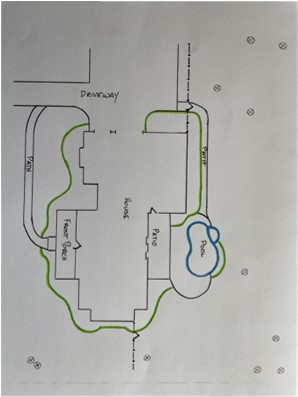 My initial drawing.
The first Sun Path map I created was recorded every hour on the hour but once every two hours works as well. When I finish my drawing I make copies. If you choose to observe once every two hours make seven copies. If observing every hour make fourteen copies. Label each copy with the date and hour of observation, example: 6:00 a.m., 8:00 a.m., 10:00 a.m., 12:00 p.m., 2:00 p.m., 4:00 p.m., 6:00 p.m.
Next: On the day you have chosen to map your Sun Path gather the copies of your initial drawing, a colored highlighter, a clipboard (or hard surface) and a timer. At 6:00 a.m. make your first observation. Go outside, walk around your property, look at the ground. Using your highlighter on your 6:00 a.m. copy, color in any areas where you see sunlight. Set your timer for two hours and do the same on the 8:00 a.m. copy.
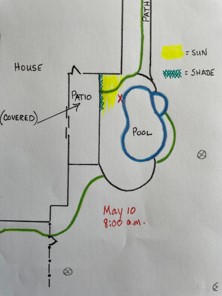
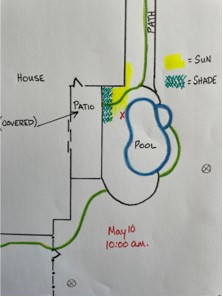 Here are my hourly observations for 8:00 a.m. and 10:00 a.m.
I focused in on the area that corresponds to the photos below. For instructional purposes I’ve indicated both sun and shade on these drawings. You don’t have to show the shade on your map, it will be evident once you’ve highlighted your sun areas.
Continue to set your timer and record your observations every two hours until the remaining copies are complete. When you have recorded your last observation you are done. Now you have one of the most useful garden tools in the shed.
Additional Information
- If you prefer, instead of a drawing, you can take pictures of your property and label with the day and hour of observation.
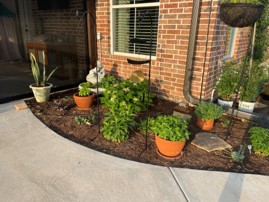
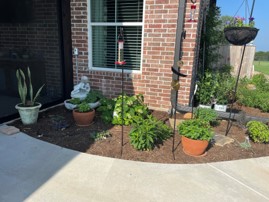
– In these two photos you can see the corner on the left in this bed received somewhat less than two hours of sun and it will be in shade for the rest of the day. While the right side of the bed will receive much more than that as the day goes on.
- Your drawing does not have to be drawn to scale.
- If you don’t want to make this a full day exercise you can do it over two or three days, just be sure to observe at least once every two hours between 6:00 a.m. and 8:00 p.m.
- There is no wrong way to record your Sun Path. Be creative, do what works for you.
That’s all there is to it. I hope your Sun Path map is an eye opener, helps you make good choices and brings you great gardening success.
*My thanks to Lucy Harrell who taught me how to map my Sun Path many years ago.
Somervell County Master Gardeners Are Proud To Present!
Let’s Get Physical, Physical!
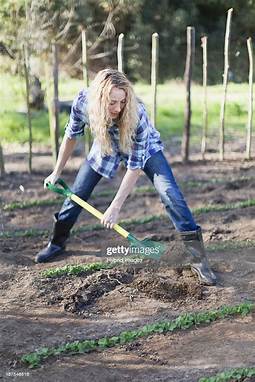
You got that right! Gardening is most definitely physical! Join the Somervell Master Gardeners on Monday, June 20, 2022 at 6:30pm at the Somervell County Citizens Center, 209 SW Barnard, as we host Physical Therapist Caleb Melde. Caleb will be demonstrating – and we will be doing – specific exercises and movements that support the positions and tasks that are required for gardening. This practice can help alleviate injuries and support recovery from our gardening chores.
This will be an active class, and we will be following along with Caleb as he demonstrates the movements. Exercises bands will be used, so if you have your own, please bring them as we will have only a few to share.
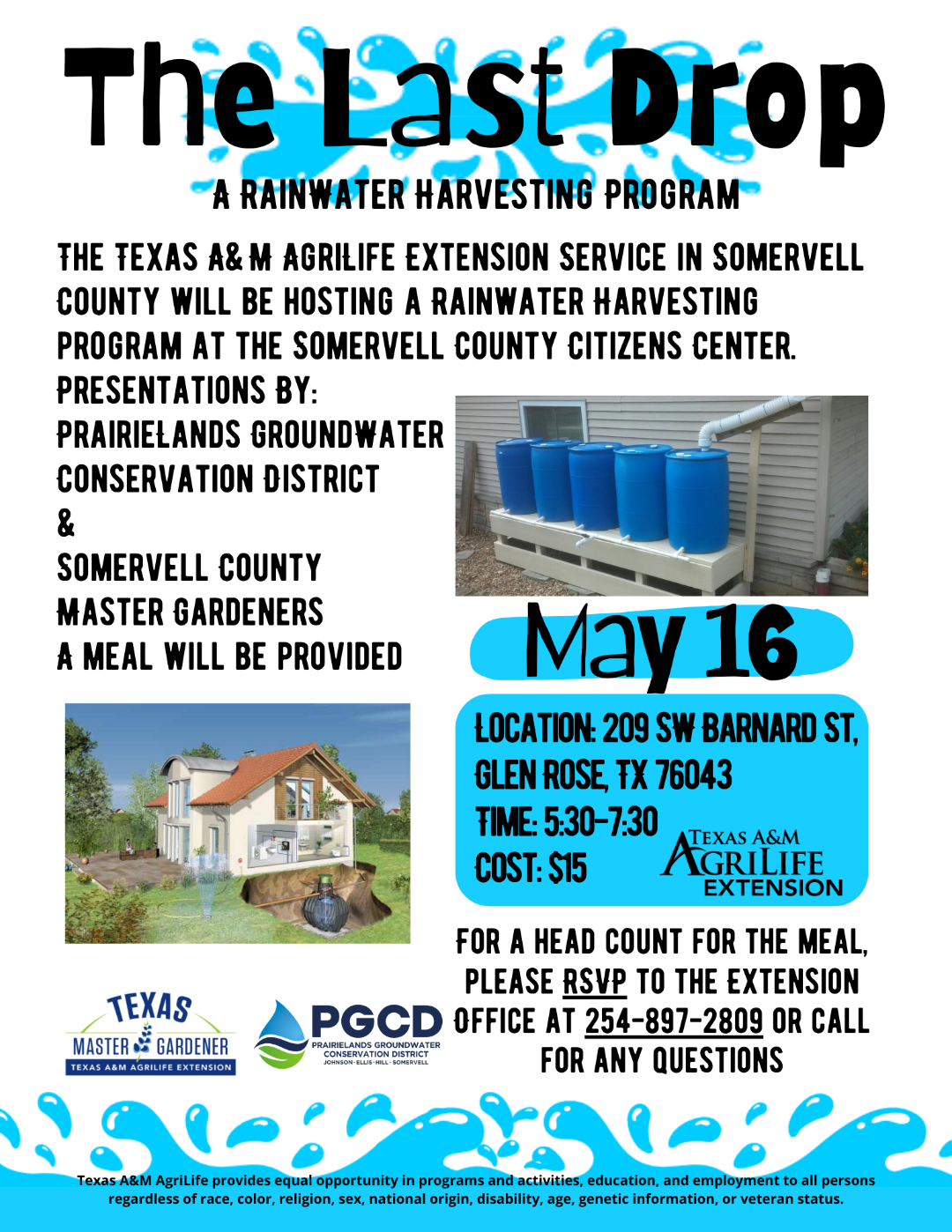
Rainwater Harvesting Workshop
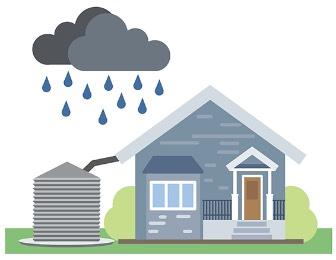
Rain, rain you need to stay
I need to use you another day!
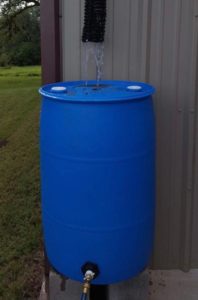
And the best way to do that is with a Rainwater Harvesting System.
Come and join Texas A&M AgriLife Extension and Somervell County Master Gardeners Monday evening, May 16 at 5:30pm at the Somervell Citizens Center, 209 SW Barnard, Glen Rose for dinner, and learn how to get started with your own rainwater catchment system. Sinclair Newby with Prairielands Groundwater Conservation District will show all the benefits of and methods for starting a variety of rainwater catchment and collection systems. She will discuss raingardens and how native plants can aid in the preservation of our precious rainwater. Sinclaire will demonstrate how to construct a simple cost effective rain barrel, and one lucky participant will take home their own 55 gallon rain barrel to get started at home!
Please RSVP to 254-897-2809
Cost $15
Please Join Us for Food, Fun, and Fabulous Information!
A Huge Thank You!
The Somervell County Master Gardeners would like to extend a heart felt thank you for a very successful 2022 Spring Plant Sale. Even before the day of the sale, the local merchants were so generous to allow us to post flyers advertising our event. Thank you so much! We are also very grateful to the Glen Rose Methodist Church for allowing us to transform their parking lot into a plant nursery for the day! It is said the most important thing when trying to sell is location, location, location, and we had the best! A huge thank you to the Somervell County Sheriffs who spent time the night before the sale patrolling the site and ensuring everything, including some of our members, were safe and undisturbed. Hats off to you! If you attended the sale you were sure to notice the excellent service of the Somervell County 4-H kids. They gave up some of their free time to assist the Master Gardeners and the shoppers. You all went above and beyond, and we were so happy to hear so much positive feedback! Of course, great kids come from great families and leaders, so thank you to Jana Reynolds and the 4-H families. You have reason to be proud. We were also fortunate to have help and support from two of Tarrant County’s finest Master Gardeners, Margaret Shuping and Avice Ward, who worked the “Ask a Master Gardener” booth. And, last but certainly not least a big SCMG thank you to our customers! We hope you enjoyed the morning as much as we did.