There will be NO Community Horticultural Education Series Program in January. Please watch your email for information on our February 9, 2015 CHES program!
Master Gardener Training Coming in March!
Gardening……..ahhh, to dig in the dirt, watch little seedlings sprout and grow into beautiful flowers, plants, vegetables or trees. Nothing can be more satisfying! Is this something that appeals to you? Have you been bitten by the gardening bug and are just not sure where to start? Or, maybe you already garden quite successfully and want to learn more? Maybe you just love to play in the dirt and want more playmates? Whatever the reason, maybe it is time to start thinking about becoming a Somervell County Master Gardener!
Just what is a Master Gardener? Master Gardeners are a dedicated group of ordinary folks who simply have a passion for gardening, desire to further their own knowledge, and wish to further good horticulture practices within our own community. They are volunteers sponsored by the Texas A&M AgriLIFE Extension Service.
To become a Certified Master Gardener one must complete the training classes and perform additional volunteer hours. By taking the training classes, you will learn not only how to plant things, but also how to keep them healthy. You will also learn to identify and prevent diseases, and how to recognize harmful, as well as beneficial insects. By the end of the class you will have a variety of tools to help problem-solve gardening issues on your own property, as well as to help friends and members of the community. All along the way you will be mentored by a seasoned Master Gardener.
The next tri-county training is scheduled for the spring of 2015. Classes will be held on Tuesdays beginning late March and running through mid-May. Location of classes will be either in Hood, Somervell or Johnson counties.
If interested, please call the Somervell County Extension Office at 254-897-2809 and give Cassie your name and contact information. You will be given priority for the class before it opens to the public. Don’t wait as class size is limited!

The Journey of a Master Gardener
By Merilyn Cranford, Somervell County Master Gardener
Since I was a small child, I’ve always enjoyed watching plants grow. I come from a long line of farmers and gardeners. So I guess growing things is in my DNA. As a child I used to watch my great-grandmother till and plant her backyard, making it into a wonderland of vegetables, flowers and herbs. Of course, her son, my uncle, had the equipment for tilling, but she did all the grubbing, watering and planting. Thinking about how hard she worked just makes me tired. But I truly believe her garden kept her active even into her 80s at which time she had to give it up.
Along with the garden, she also planted fruit trees. During the summer months, my mother usually helped her can the fruit or make jellies. I was there watching all the activity and learning from what I saw. Grandmother passed her love of gardening on to my mother, but mother was mostly a flowerbed gardener. She had some of the most beautiful flowers blooming around our home from one season to the next. At my home today, I have some of her irises and when they bloom I always think of her and am so grateful for the blessing she passed on to me.
I can think of nothing better than leaving a legacy of gardening to the next generation. Of my three children, all have inherited the gardening DNA (if there is such a thing!) and we have such fun trying new varieties of this or that and sharing the results with each other.
I spent my childhood in the Dallas area and grew to understand what it takes to garden successfully in the blackland of Texas. But as the years passed I have found myself living in many areas of Texas, from the coastal plains to the areas that border west Texas. In each, I found a challenge that opened up new vistas of learning. I became what I call a “trial” gardener. Try growing something, if it produces, great! If it doesn’t, dig it up and try something else. Through this trial and error method, I’ve learned what works and what doesn’t. But it wasn’t until 2007 that I really began to learn what it means to know about gardening and put that knowledge into practice.
In the spring of 2007, my husband noticed an article about the next Master Gardeners Training to be held and mentioned it to me in case I might be interested. So I sprang into action and enrolled. How glad I am that I did! The training was interesting and enlightening and as a result I now don’t depend on my trusty “trial and error” method of gardening any more. Best of all, I met some of the most interesting people. People who were interested in gardening, just like me. I might also add that my sister-in-law, who lives in Tennessee, was also enrolled in the master gardeners training in her state. As a result, we have so much in common and so much to share. So the timing for the training was just right and I truly enjoyed all the different lecturers, field trips, and hands-on activities.
Of course, I’m not an authority, but feel like I have just begun learning to garden with a sense of confidence I didn’t have before. I feel a sense of accomplishment when I step back and survey what has been accomplished in a day’s time. I’m tired, yes, and sore as well. But the feeling is good. Why not try it yourself? And don’t forget our new training classes are scheduled to begin this spring. Come join us!
Know Your Soil
By Kathy J Gosdin, Somervell County Master Gardener
Happy New Year to you all! If you have recently purchased your property, have became interested in tilling some dirt to plant a tree or need to figure out why things just don’t grow or produce the way you would like, you may find it beneficial to have your soil tested. Obtaining a nutrient analysis of your soil helps you to know how to properly amend it.
Testing for nutrients in the soil may be done through Texas AgriLife Extension Service Soil, Water and Forage Testing Laboratory. You may get an analysis from any lab of your choice but know if you send the soil sample to a commercial laboratory instead of the one at Texas AgriLife Extension Service, be sure to use an agronomic soil testing laboratory, not an environmental soil testing laboratory as most environmental laboratories are unfamiliar with agronomic soil testing and therefore may not make nutrient recommendations. Soil bags for sample collection and information sheets are available from your county extension office or line at http://soiltesting.tamu.edu/files/soilwebform.pdf .
There is a cost for the test and you do have to send it to the Lab, but the information you gain could give you the knowledge you need to have the success and enjoyment of watching your plants thrive.
Just know the accuracy of the soil analyses will be a reflection of the quality of the sample you have taken. It is recommended that a good representation of the area be gathered. Here are some steps to follow:
- Use clean tools to retrieve the sample. Chose 10 random areas to a depth of 6 inches. Areas to avoid would be manure or compost piles, under eaves or near gavel roads or brush piles.
- Place the samples into a clean container and thoroughly mix them.
- Retrieve about a pint of the mixed soil placing it into the bag from the county agent or you may use a zipper-lock sandwich bag, just be sure to double-bag that sample if you do.
- Number the samples if you send multiple. Also identify the samples so that you know where you got them from. Two labels per sample is also good in case on gets messed up.
This procedure should be done for each area that you wish to get analysis on and if the area is small you may collect as few as three samples to mix up to obtain the one pint to send in.
As we mention so many time mulch and compost do so much in the way of improving your soil. Whether it be sandy loam or clay. Microorganisms are needed in your soil to help break down the nutrients your plants will feed on.
The nutrient analysis will return to you with results of levels and recommendations of fertilizer to use.
Knowledge is useful, correctly applying knowledge is wisdom
– may you be a Wise Gardener/Yardener.
Sources: Doug Welch’s Texas Garden Almanac
Texas Master Gardener Handbook
Donna Hagar Elected President of Texas Master Gardener Association

2015 TMGA President Donna Hagar, left, from Somervell County Master Gardener Association. Other 2015 TMGA Officers, Mary Means, 1st VP, of Collin County MG, Peggy Rogers, 2nd VP, of Wood County MG, Dale Powell, Treasurer, of Denton County MG and Nicky Maddams, Secretary, of Grimes County MG.
On Saturday, December 6, 2014, local Somervell County Master Gardener, Donna Hagar, was elected 2015 President of the Texas Master Gardener Association during the quarterly Board of Directors meeting held in College Station. Donna became a Master Gardener in Somervell County in 2007 and served as President of the local association from 2008-2012. Donna was co-chair of the 2011 Texas Master Gardener Association State Conference, held in Glen Rose in April 2011.
Donna has fulfilled the duties as a member of the Board of Directors of the Texas Master Gardener Association as a representative from Somervell County since 2008. She took over the TMGA Newsletter editor position in 2008 and went on to serve on the TMGA Executive Board, first as Treasurer, 2011-2012 and then 2nd and 1st Vice President 2013-2014 respectively.
Master Gardeners Give Donation to Texas A&M Gardens and Greenway Project
On Saturday, December 6, 2014 Donna Hagar, presented a $5000 check from the Somervell County Master Gardener Association to Dr. Doug Welsh, as a donation for the Texas A&M Gardens and Greenway project. This donation will be combined with funds from other Master Gardener Associations in Texas in an effort to raise $100,000 for the naming rights to a portion of the Texas A&M Gardens and Greenway Project, specifically The Texas Master Gardener Earth-Kind® Garden.
The Texas A&M Gardens and Greenway project will be a premier teaching garden on the west campus of Texas A&M University. As they strive to be one of the top ten universities in the nation, one thing that has been missing from the campus is some sort of garden or arboretum complex. The Gardens and Greenway project will not only restore and preserve the White Creek and surrounding riparian area but will bring to Texas A&M an outdoor classroom for all agriculture disciplines as well as a peaceful sanctuary where everyone who attends or visits A&M can relax and learn.
Dr. Doug Welsh is leading the charge for the Gardens &Greenway project. Founder of the Master Gardener program in the state of Texas, Dr. Welsh knew that the Master Gardeners have carried the torch of the Earth-Kind® principles for decades. Having a Texas Master Gardener Earth-Kind® Garden is a befitting recognition for the continued efforts the Master Gardeners make preaching the gospel of the good news of Earth-Kind® throughout Texas. The Texas Master Gardener Earth-Kind® Garden will be a 3 acre portion of the whole 45 acre Gardens &Greenway complex, containing 14 separate gardens including an herb garden, butterfly garden, wildflower meadow, vegetable gardens and more.
The Somervell County Master Gardeners were one of the first groups to lead the charge in raising funds for the Texas Master Gardener Earth-Kind® Gardens. To date, over $25,000 has been raised for this particular naming endeavor. For more information on the Gardens and Greenway project, visit www.youtube.com/watch?v=M-RRz5VzRLs
American BeautyBerry
By Donna Hagar, Somervell County Master Gardener
Common Name: American Beautyberry – Botanical name: Callicara americana
American beautyberry is a fast growing native perennial shrub; growing five to eight feet tall and almost as wide. It has long, arching branches and yellow-green fall foliage, but its most striking feature is the clusters of glossy, iridescent – purple fruit (sometimes white) which hug the branches in clusters along the branches in the fall and winter.

The fruit is an important food source for more than forty species of songbirds. The berry clusters are eaten by armadillo, foxes, opossum, raccoon and squirrels. White tailed deer consume the fruit in the fall after leaf drop. They will also browse the leaves in summer when highly preferred foods are not available.
The roots, leaves, and branches were used by various Native American tribes for medicinal purposes to treat fevers and rheumatism. In the early 20th century, farmers would crush the leaves and place them under the harnesses of horses and mules to repel mosquitoes. The farmers rubbed the crushed leaves on themselves to repel mosquitoes and biting bugs.
American beautyberry is used as an ornamental shrub in mass plantings or borders or can stand alone as a speciman shrub. It is best suited to semi-shaded sites with some moisture. It is remarkably tolerant of various soils and habitats.
I can attest that this is one hardy shrub. I transplanted a sapling from a friend in the dead heat of August. It has been dug up by armadillos and my chickens several times, but hasn’t given up yet! Maybe next year the chickens will be able to eat the berries!
Ahhhhh! October Gardening Tips
by Donna Hagar
As the days get cooler and chances of rain return, we are all finding it to be far more enjoyable to be back in the garden. If you are like me, there are some chores that need to be done, as well as some fun things to get excited about!
First and foremost, if you haven’t cleaned up your summer veggie garden, now is the time to do so. Any dead or spent veggie plants can go straight to the compost, if they aren’t diseased.
If you are wanting some fall crops, there is still time but you will need to get on it PDQ. Add compost to your garden and work it in the top few inches. There is still time for root veggies – beets, carrots, radishes, turnips and parsnips if you lean that way. Also greens such as collards, kale, lettuce, mustard, spinach and Swiss chard. Maybe now you will want to try some Chinese cabbage varieties, bok choi, tat soy or pak choi. And of course, get the garlic in! And as most people are unaware, cilantro is a cool season plant, so it goes in now, too.
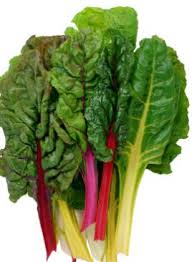
Veggies not your thing? How about annuals for color? Pansies can go in, as well as pinks, dianthus, ornamental kale, snapdragons. Don’t forget, Swiss chard comes in many colors and withstands the winter quite well. If you haven’t eaten it before, give it a try! Mix some in with your landscape and save a trip or two to the grocery store for veggies! Spring flowering bulbs, daffodils and narcissus go in this month.
Fall is actually the ideal time for planting container grown trees and shrubs and many perennials. Getting them in now gives them several months head start to get their roots established before the spring growth and hot, dry summers next year.
Divide those perennials now, as well. Daylilies, iris, oxeye and Shasta daisies, coreopsis, purple coneflower all will handle a fall transplant or being passed along to some favorite friend. Leave ornamental grass inflorescence for fun winter color. Trim just before spring growth begins.
This is your last chance to get wildflower seeds out as well but get to it quick. Make sure there is good seed to soil contact for best germination. Fall rains and Mother Nature should take care of the rest.
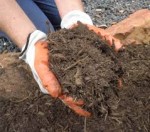
And last but not least, mulch, mulch, mulch! Get a new 2-4” fresh layer of mulch on all those existing beds to protect it from potential early freezes! (Don’t cover seeds in the garden tho or they won’t sprout!) It also helps retain moisture thru the winter and prevents weed seeds from germinating. Just be sure to water those beds good before adding the mulch.
Timely Tips for June
by Donna Hagar, Somervell County Master Gardener
Ahh, wasn’t all the rain we got in May just wonderful? Everything greened up and flourished. You could tell the trees, grass and shrubs were heaving a huge sigh of relief! This is a great time to want to sit back and really enjoy our lush and thriving landscapes. But what if that was it? What if the rains will be fewer and farther between? What can we do to keep our trees, plants, gardens and lawns happy?
For starters, MULCH! This is something we Master Gardeners push very hard, as it makes such a difference in retaining moisture and keeping weeds at bay. And I’m not talking a scattering or just top dressing of mulch. More like 3-4 inches thick. Just make sure the soil underneath is good and moist before you load that much on top. If you have drip irrigation or soaker hoses, place these under the mulch, as it takes quite a bit of water to get thru that thick layer of mulch. When you do water, you want to make sure you are actually watering the soil so plants can get their much needed drink.
Be sure to stay on top of weeds. We don’t want our precious plants competing with weeds for water and nutrients. That thick layer of mulch will certainly help keep weeds at bay as well. And weeds that do come up in heavily mulched beds generally have germinated in the mulch itself and will pull up very easily.
In the vegetable garden, as crops are harvested and completed bearing, be sure to keep weeds in check in areas that have been vacated. Add organic matter and keep the area mulched to be ready for fall crops that will begin going in next month.
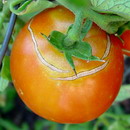
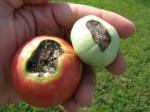
Oh and by the way, if you have tomatoes or squash with blossom end rot on the bottom or are cracked and split toward the top, this can easily be attributed to the fluctuations in moisture.
Blossom-end rot (BER) is generally caused by a lack of calcium being taken up in the plant. Soil moisture fluctuations we have had lately can reduce the uptake of calcium in the plant and can lead to BER.
The cracking is caused when the tomatoes get too much water too fast and the skin can’t stretch enough to accommodate. These are still edible by cutting off affected areas. Keep the soil consistently moist (ah, that ever important mulch can help) and both conditions can be kept under control for future harvests.
Mistletoe – Friend or Foe?
By Donna Hagar, Somervell County Master Gardener
It must have been the mistletoe
The lazy fire, the falling snow …
… It only took one kiss to know
It must have been the mistletoe!
Ah, tis the season for the quintessential mistletoe. Mistletoe is an important part of the holiday season. Many girls and boys stole their first kiss by standing under mistletoe branches.
Unfortunately, mistletoe has some qualities that Christmas love-birds probably prefer to ignore. Mistletoe, or Phoradendron tomentosum is a parasitic plant, growing on limbs of trees, with elms and hackberries favored among our native trees. Mistletoe can grow 2-5 feet in diameter, and with its evergreen foliage, becomes highly prominent in our landscape trees in the winter, when their host trees have lost their leaves.
As a parasitic plant, mistletoe grows into the wood of the host tree sucking water and minerals. Even though mistletoe is a true plant, meaning it can make its own nutrients from photosynthesis, it is the use of the tree’s water resources that can cause the biggest problems.
While mistletoe rarely kills entire trees, limbs are certainly weakened by the loss of water, and with the added drought endured the last few years, mistletoe is just one more added stressor that trees must overcome, and thus may make the tree susceptible to other problems.
While mistletoe is present 12 months of the year, the high visibility during the winter months springs homeowners into action to control the plant. Small infestations can be controlled simply by removing infected limbs at least 12 inches below the mistletoe. Because the roots of mistletoe are embedded into the tree tissue, cutting just the plant, leaves roots behind that will just sprout more mistletoe.
Again, because the root system is so closely tied to the vascular system of the trees, chemical controls are not affective without also adversely affecting the tree.
Mistletoe produces white berries, which are eaten and spread by birds. It takes 2-3 years before a mistletoe plant matures to produce the berries, so control early is the most promising means of keeping it in check.
Are there benefits (other than the obvious ‘first kiss’) to this prolific plant? As mentioned above, birds do feast on the berries, which are high in fat and full of protein. Other mammals, deer, squirrels and porcupines also partake in the berries. Several bird varieties nest in the foliage of mistletoe. Mistletoe is host to 3 varieties of hairstreak butterflies. Research is also being done on the extracts of mistletoe in the treatment of certain cancers.
So, friend or foe? Although a parasite that can weaken affected trees, trees can survive well with small infestations. So removal is recommended if it can be done safely and economically.
Resources: aggie-horticulture.tamu.edu; National Wildlife Federation Dec/Jan 2014