Stephen Brueggerhoff, CEA – Horticulture, Brazos County AgriLife Extension; published 3/31/2026
All images unless otherwise noted by Stephen Brueggerhoff
Texas sage (Leucophyllum frutescens), also called Cenizo, has made quite an impact in the commercial and retail trade over the past decades. They are woody evergreen shrubs valued for low maintenance, silver green foliage and contrasting pink to mauve flowers. Its native distribution in Texas is in to calcareous soils of the Rio Grande Plain, Chihuahuan Deserts, and Edwards Plateau Ecoregions. There are two additional species found in Texas; Brewster County barometer bush (Leucophyllum candidum) that is endemic to its namesake county, and Big Bend barometerbush (Leucophyllum minus) that has a distribution from Pecos, Brewster and Presidio County, and travelling north into Eddy County in New Mexico.
Texas Sage Valued for Foliage Form and Flower Color
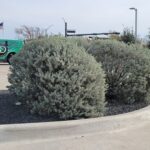
The beauty of Texas sage is expressed through bicolored foliage, gray green to green on the upper leaf surface and silvery gray below from a fine matte of silver hairs. The species expresses sparse branches that can reach 10-foot tall and 6 feet wide. The plants’ height and spread can be controlled by either selective limb pruning or shearing. There are varieties such as ‘Compacta’ that reaches 4-foot tall and wide. A newer hybrid ‘Microburst’ (L. frutescens x candidum) reaches 3.5-feet tall, keeping a consistent uniform shape, is tolerant of variable soil texture and offers fragrant flowers. All species and varieties are drought tolerant, and care should be taken to cultivate them in well-draining soil. The plants require minimal maintenance once established and should not be fertilized unless there is a nutritional deficiency documented through soil test.
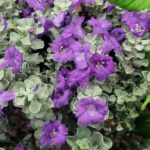
Texas sage is valued for floral displays of magenta bell-shaped flowers that contrast with foliage color. They are effectively used as a hedge, can add focus as a mid-accent and grouped planting in a xeriscape landscape bed. They can also be cultivated as specimen planting in a patio container. Flowers are produced on new wood, and the shrub can be pruned early to mid-spring and then maintained with light pruning in a natural shape for the remainder of the year. Discontinue pruning in fall as the plant begins a period of winter dormancy. The plant is also called Barometer bush for a coincidental habit of flowering after seasonal rain. They typically begin blooming in early summer and then sporadically dependent on environmental conditions through to fall. While the plant responds well to formal pruning into box or ball shape, continued techniques used to create topiary will reduce flower production. While shrub flowering is induced in a high humid environment, care should be taken to not overwater the plant as they are susceptible to root rot.
A Number of Varieties To Fit Your Aesthetic
There have been quite a number of varieties that have become available over the past few decades to fit your lifestyle and aesthetic:
- ‘Silverado’ produces fuchsia flowers on silver foliage with denser canopy than the average Texas sage
- ‘Silver Spirit’, a 2026 release, is reported to be tolerant of wetter soil conditions and have modest growth at 5-feet tall and 3-foot wide
- ‘Green Cloud’ is a standard and was released in 1983 by what was then called the Texas Agricultural Experiment Station (Texas A&M AgriLife Extension Service today). ‘Green Cloud’ offers consistent shades of green foliage with dark pink to magenta blooms and is a more prolific bloomer than other varieties. ‘White Cloud’ was also released in 1983 by the Texas Agricultural Experiment and produces white blooms.
- ‘Lynn’s Legacy’ is a selection derived from species L. langmaniae, native to mountains in the Chihuahuan Desert of Mexico. The variety is named in honor of plantsman Lynn Lowery (1917-1997). The shrub offers a longer flowering period than others on the market and grows 5 feet tall and wide.
- ‘Desperado’ is 5 feet tall and 5 feet wide with silvery-green foliage and lavender-pink blooms.
Springtime allows us an opportunity to rejuvenate our gardens, and Texas sage may just fit your needs as you redesign your landscape. Just remember to keep Texas sage high and dry for continual enjoyment throughout the year. You can always chat with me on Garden Success, my live call-in garden radio show every Thursday at 12 pm on KAMU-FM 90.9 with your spring planting. I always look forward to sharing gardening tips with you, and I’ll see you in the garden.