Stephen Brueggerhoff, CEA – Horticulture, Brazos County AgriLife Extension; published 9/15/2026
All images unless otherwise noted by Stephen Brueggerhoff
Ornamental salvia is a welcome sight at the end of summer, visually attractive to us and offering inspiration for next spring planting season. They are also an important nectar resource for pollinators. I shine a light on this group of one of my favorite plants that offer a variety of leaf textures, flower color, and fit the bill attracting beneficial insects and hummingbirds.
Globetrotters and Pollinator Magnets
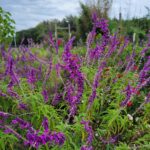
Salvia is a large genus of the Mint Plant Family (Lamiaceae), with an estimated 900 species found globally and over 500 species native to North, Central and South America. Species are favored for their floral display, offering bold colors with individual flowers paired along 3 to 9-inch racemes and looking like colorful wands dancing gracefully in the wind. Each flower offers a small, tapered tube shape behind two-lipped fused petals, the top petals forming a kind of hood and the bottom petals offering a landing pad for insects to forage nectar. An interesting part of the flower you do not see is a stamen that acts as a lever, depositing pollen on the back of an unsuspecting insect as it snuffles its way to extract nectar welled at the inside bottom of the floral tube. Blooming season is late spring to first frost, with highly attractive colorful racemes available for hummingbird visitation, as well for native bees and other insects.
While we enjoy their summer floral display, it is best to plant them after your region’s last spring frost. Most of the ornamental salvia we bring into our garden are herbaceous perennials, with some like Scarlet sage (Salvia coccinea), a Texas native that will die-back in freezing temps and treated as an annual planting. Most perform best in full sun in well-draining improved soil. They generally offer erect vegetative growth, with a few cultivated as a rounded subshrub. All have a manageable growing height, outstanding leaf texture and sometimes pleasant vegetative fragrance.
Salvia That Meet Your Garden Design Needs
One popular salvia is Autumn sage, Salvia greggii, naturally distributed from south-central and west Texas to San Luis Potosi, Mexico. Autumn sage forms a compact 3-ft tall by 2-ft wide subshrub best cultivated in full sun. Autumn sage does not perform well in clay soil with poor drainage. It is found in rocky areas with shallow soil profile, and it is best to plant this species in a raised bed in well-drained, enriched soil. Considered to be semi-evergreen, it produces thin, almost waxy leaves up to 1/4-inch wide and 1-inch long on brittle woody stems. The beauty of this shrub lies in its ability to bloom from spring through first frost. Flower color ranges from red, pink, orange, and white to magenta.
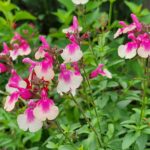
There are hybrids of Autumn sage and Little leaf sage (S. microphylla) that have become popular and available at nurseries and garden centers with trade names like ‘Hot Lips’, offering bi-colored flowers. One selection is called Mirage™ Rose Bicolor Autumn Sage, exhibiting pink-blush on the upper petals and descending to pure white on the lower. Autumn sage and cultivars present a short floral tube with a flat face that I mentioned earlier; if you look at them straight on, they kind of resemble a dancer in gaucho pants. Another commonly found salvia is Tropical sage, S. coccinea. Tropical sage can be managed in part-shade to full sun areas of the garden. Like Autumn sage, it can bloom on and off from spring to first frost. This species exhibits larger leaves, up to 1-inch wide and is less drought tolerant. The plant has more of an upright growth, and in flower can reach 3-ft tall. Floral colors range from red, pink to white.
From Sprawl to Tall Growth Habit
Another commonly available species is Texas native Mealyblue sage, S. farinacea. This perennial has a sprawling growth habit, reaching 2-ft tall and producing velvety purple flowers on floral spikes extending 1-ft beyond its canopy. Mealyblue sage will bloom sporadically from spring to fall and is drought tolerant. There are two outstanding selections discovered many years ago by AgriLife Extension Horticulturist Dr. Greg Grant that are popular favorites. Texas Superstar® ‘Henry Duelberg’ stands out with bright-purple flowers and wider lance-shaped leaves, and variety ‘Augusta Duelberg’, offering more compact spikes of flowers that are white.
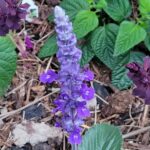
Additional varieties you may consider for the garden with a taller profile and offer larger, tubular-shaped flowers are ‘Amistad’, a hybrid with South American species Salvia guaranitica and shows off with rose-purple petals and calyx. A species selection ‘Black and Blue’ presents flowers with deep purple petals and almost black calyx. I recommend interplanting ‘Black and Blue’ with other plants that provide contrasting colors as the flowers may seem to disappear in the garden. You may consider Salvia Skyscraper™ Red, very eye-catching with pure red flowers. Keep in mind these varieties are frost tender and will need protection during the winter months. I leave you with two more drought tolerant and hardy salvia, Texas Superstar® plants ‘Mystic Spires Blue’, a hybrid with compact growth up to 30-inches with true-blue flowers. Mexican bush sage, Salvia leucantha, stands out at the back of a mixed garden with 3-ft tall and wide growth, expressing lance-shaped leaves with a velvety gray-green color. The foliage provides excellent texture and color as we wait until fall for velvet-textured spikes of purple and white blossoms.
Celebrate pollinators at Wings in the Garden on September 26, 2026 starting at 9 am. Wings in the Garden is a free family-friendly event hosted by Brazos County Master Gardeners at our Demonstration Idea Garden at 2619 West Hwy 21 in Bryan. Kids are invited to come dressed up in their favorite pollinator costume and buzz through our garden on a scavenger hunt, visit tables with pollinator activities and a crafting station, and visit with partners Brazos Valley Master Naturalists, a Master Beekeeper candidate, Brazos County 4-H Agents and Brazos County Master Gardeners. We also offer separate education seminars such as Bulbs for Brazos County at the Clara B. Mounce Library in downtown Bryan, and Brazos Valley Gardening seminars at our Brazos County AgriLife Extension office. Find out more details from our website: txmg.org/brazos. Always sage advice and I’ll see you in the garden.