Stephen Brueggerhoff, CEA – Horticulture, Brazos County AgriLife Extension; published 6/23/2026
All images unless otherwise noted by Stephen Brueggerhoff
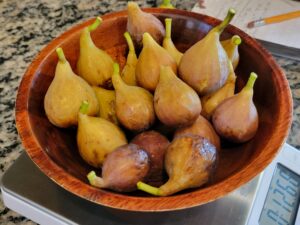
I’m delighted to report that fig fruit are beginning to ripen and are ready for picking. Fruit availability may seem to go by in a flash as fresh fruit is highly perishable. Unlike tomatoes that can be harvested at the breaker stage, figs will not ripen on the countertop until in the later stages of ripening on the stem. A crop of figlets from my in-ground variety Celeste developed about a month ago, and I am fortunate that it has produced almost four pounds as of this writing with more to come.
Figs Are Healthy and Tasty
Figs offer health benefits that include high dietary fiber content, a great source of calcium and potassium and easily digestible natural sugars. Fresh figs are favored for their jam-like, delicate texture. I smile when I read flavor descriptors like those used by a sommelier – the all-encompassing berry with hints of vanilla, or light cherry with a syrupy interior. I speak from direct experience and report on the sweet and sugar jam flavored profile of Celeste and Little Ruby, an aroma of fresh strawberries from green skinned Nagle, and the light honey flavor of LSU Gold. I have a variety called Smith that offers a rich taste, one that is difficult to describe but is outstanding in flavor.
Fig Varieties
There are hundreds of named varieties, each offering difference in taste, texture and harvest time. I offer a few recommended for ease of cultivation and consistent producers.
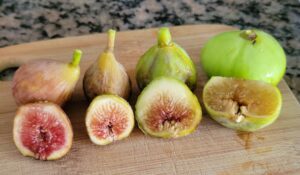
- Celeste, a popular dooryard tree, produces a light-bronze fruit averaging 1.5-inches in diameter with a closed eye. It has the capacity to produce ten pounds annually from mid-June thru July. Reddish pulp offers a rich, sweet taste when fully ripe. Celeste is a cold hardy tree, down to low teens with short duration freeze event.
- LSU Gold was developed through Louisiana State University’s fig breeding program and reached commercial markets in 2001. The fruit is a large 2-inch diameter oblate form, offering a greenish-yellow skin when ripe and the potential to produce 24 pound in one season. The tree begins producing fruit in mid-June. The pulp is light pink to amber color with a honey-like flavor. Mature fruit has a partially closed eye (ostiole). One challenge is the fruit may split or crack with excessive moisture from rain events during maturation.
- Smith was brought by the Becnel family to their nursery in Louisiana in the early 1900s. Reputed to be a classic southern fig, Smith produces from June through early July and expresses an exquisite berry taste. You know when Smith is ripe when the skin expresses prominent purplish ribs and an amber droplet emerges from the semi-open eye.
Cultivating Fig Fruit
If planting anew, wait until early spring and after anticipated hard freeze events in well-drained soil. Do not fertilize and prune newly planted trees to half their height, forcing shoots to grow from the base of the plant. The following late winter, select three to five vigorous leader shoots and prune back to one foot from the base. Ensure each leader is widely spaced to accommodate up to 3-inches of girth as it matures. Other than dwarfed varieties like Little Miss Figgy, Little Ruby and Fignomenal, all fig trees can become quite large at 20-feet or more tall and wide. Give them room to grow and prune annually mid-February to early March to keep at a harvestable height. Use thinning cuts, removing branches to their lowest point and avoid heading cuts that shorten branches and encourage vigorous, upright sprouts.
While annual maintenance includes fertilization, apply with caution as fig trees can respond vigorously with little to no fruit production. My advice is to submit a soil sample to the Texas A&M AgriLife Extension Soil, Water and Forage Testing Laboratory (soiltesting.tamu.edu/) and determine any nutrient deficiencies for a more accurate measure of fertilization. For newly planted trees and after the first year in the ground to around three years, split approximately 3 cups into thirds and apply early spring, mid-May and mid-June. Mature established trees can be fertilized once in the spring annually. LSU Extension recommends annual application from half to one pound per year of plant age and no more than ten pounds per plant at maturity. Cut back on the fertilizer application next year if the foliage growth outcompetes fruit production. The fig season may seem to go by in a flash, but I encourage you to cultivate at least two for your backyard orchard to extend the bounty. Figs are truly a part of our southern culinary culture, and I look forward to sharing knowledge and supporting your urban orchard efforts. You can always chat with me about figs on Garden Success, my live call-in garden radio show every Thursday at 12 pm on KAMU-FM 90.9. Fig on, my friends and I’ll see you in the garden.