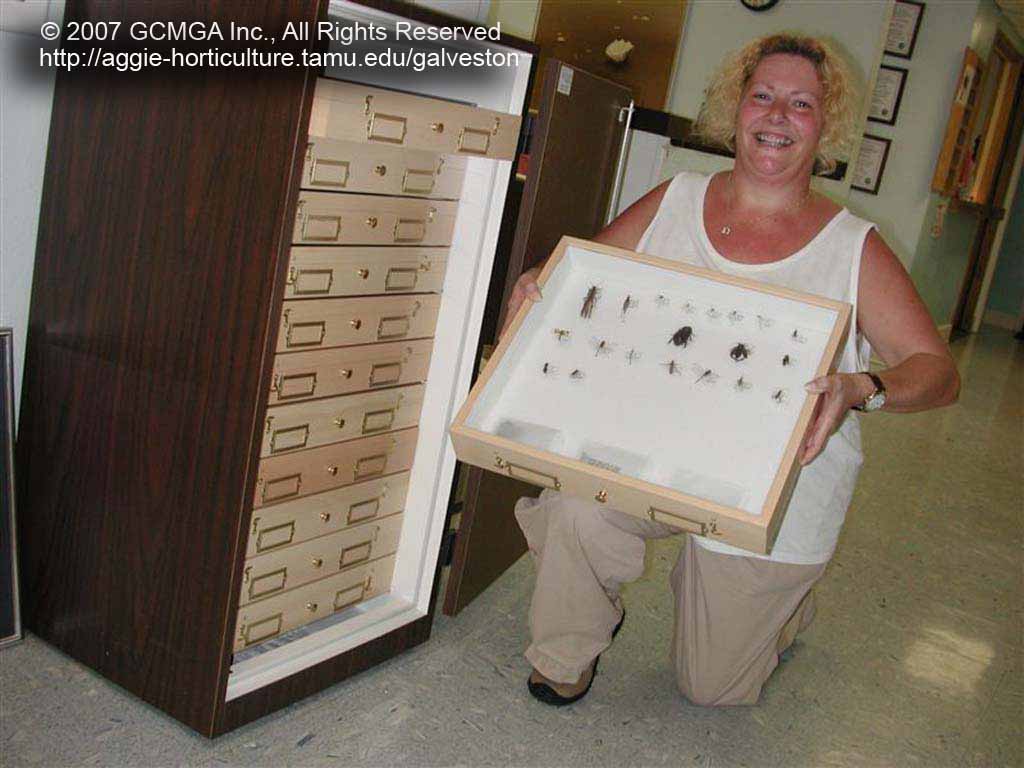
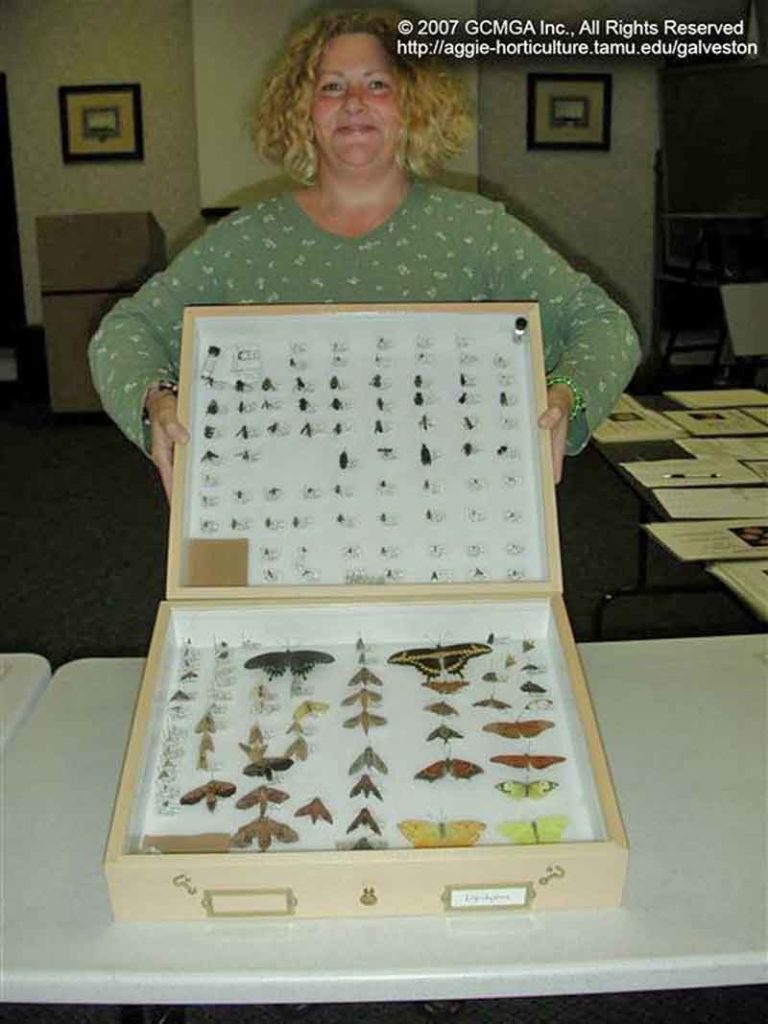
Our goal for establishing and maintaining an insect collection is to provide an educational resource for Master Gardeners and the general public. For example, we utilize our collection for comparison to specimens that are brought to the Galveston County Extension Office by county residents for identification.

I. WHY MAINTAIN AN INSECT COLLECTION?
When asked what motivated this author to start an insect collection, my answer is I wanted to know more!
For example, there were two insects in my home garden that had me puzzled, as their appearances were very similar. One was the nymph stage of the Milkweed Assassin bug, typically seen alone as adults (i.e., a solitary insect) in the garden, and the other was the immature stage of the Leaf-footed Bug, often seen in family groups or clusters, ranging in size from 12 nymphs to 30 or more. The nymphs of these two insects can be easily confused.
I now know that one is a good bug” (i.e., Zelus longipes or the Milkweed Assassin Bug) and the other is considered a bad bug” (i.e., Leptoglossus phyllopus or the Eastern Leaf-footed Bug)!
I have learned that the Milkweed Assassin Bug should be left alone. As its name implies, the Milkweed Assassin Bug is a beneficial insect that can help control harmful insects. However, the Leaf-footed Bug may require some management as it is capable of causing significant damage on a variety of fruits and nuts including tomatoes, citrus and even pecans. Nature at work!
My adventure started from a need-to-know inquiry and it has flourished from that beginning. Maintaining the insect collection has been a wonderful learning experience for me as well as my fellow Master Gardeners. This resource is also available to area residents visiting the Galveston County Extension Office. It is an easy way to quickly identify an insect specimen or to confirm its identification.
III. EQUIPMENT USED & PRESERVATION TECHNIQUES
Equipment for capturing, killing and storing insects are basic items for any collector. Some tools used in collecting specimens are sweep nets or sugar traps. A large cloth stretched with two small boards, creating an X in the middle can be used to capture insects by tapping on tree or bush branches. This is called a beating sheet. For night collecting, a black light hung over a white sheet can bring out potential specimens.
Jars used for collecting usually have a small amount of dried plaster of Paris inside. Then apply a small amount of a killing agent (Ex: ethyl acetate), which is absorbed by the plaster of Paris.
IMPORTANT: DO NOT BREATHE ethyl acetate.
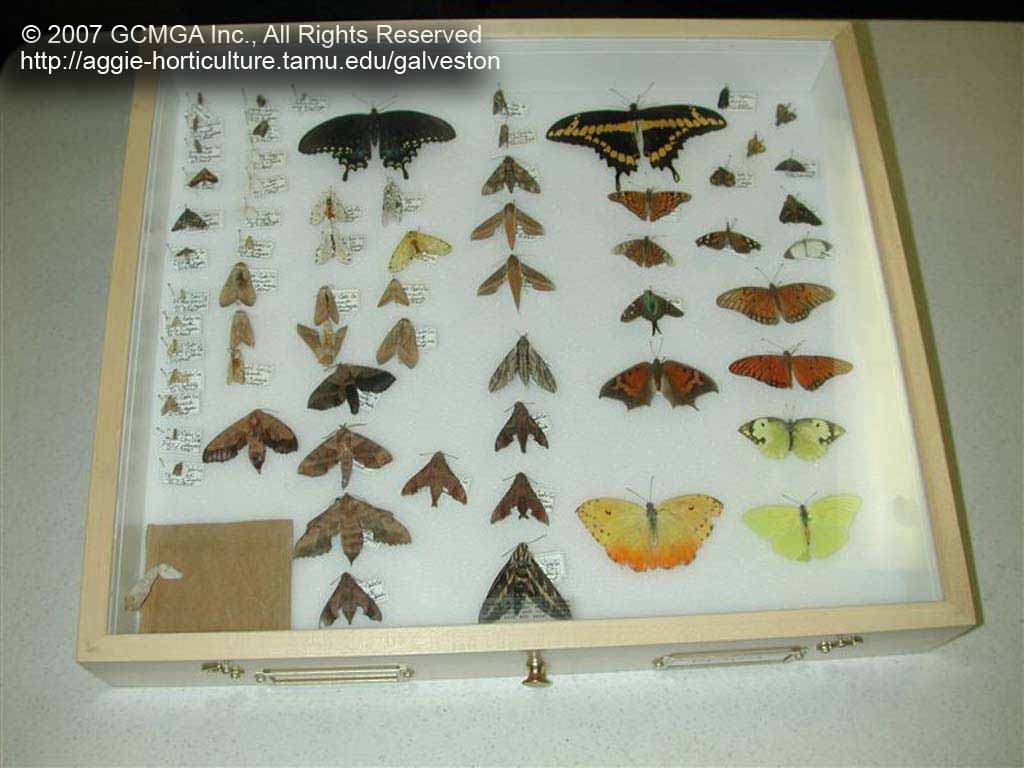
Special entomology-grade pins (No. 2 or 3), are used for pinning specimens. Each specimen must have two labels. First, a collection label stating in what county, city, date and by whom collected. The second is the identification label consisting of the genus/species name.
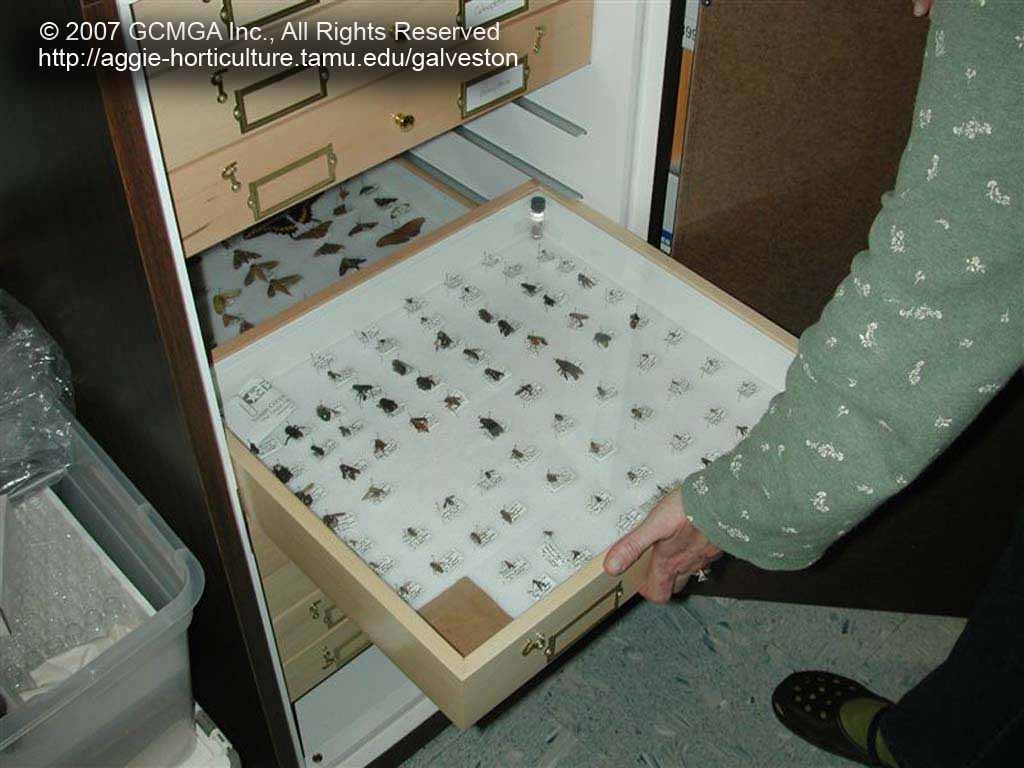
A spreading board is used for drying butterflies, moths and sometimes dragonflies. Specimens are stored in Cornell University glass-topped drawers, which fit tightly to help protect the collection.
III. CURRENT SIZE OF INSECT COLLECTION
As of December 31, 2006, our insect collection reached 502 specimens.
As of December 31, 2007, our insect collection reached 841 specimens.
IV. INVITATION TO VIEW OUR INSECT COLLECTION
You are always welcome to visit the Galveston County Extension Office. While you are there, be sure to view the specimens in our insect collection you will likely recognize many of them!