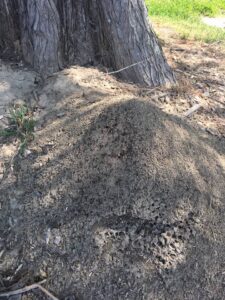
HOW to ATTACK FIRE ANTS – 6 ways….from Mississippi State University entomologist Blake Layton.
1} Granular Baits: When properly applied, granular fire ant baits are low in cost; quick and easy to apply; safe to pets, children and wildlife and effective, giving about 80% control. Baits are “fire ant-edible” granules containing low doses of slow-acting insecticides or insect growth-disruptors that are applied by spreading them over the lawn. Foraging fire ant workers collect these granules and carry them back to the mound to feed to the young. Depending on the product, it can take two to six weeks to see the full benefit of a bait treatment, but patience and persistence pays. Broadcast a granular fire ant bait over your lawn three to four times a year: around Easter, around Independence Day and around Labor Day, and you won’t have many fire ants in your lawn.
2} Dry Mound Treatments: This is the most convenient way to kill individual fire ant mounds. Keep a can of one of the dry mound treatments on hand to spot-treat mounds you see while working in the yard. Just sprinkle the labeled amount of product over the mound and walk away. Treatments that contain acephate smell terrible but work great, killing most mounds in just a few days. Treatments containing deltamethrin or beta-cyfluthrin don’t smell so bad but tend to be less consistent. Use a combination of granular baits and dry mound treatments to knock fire ants out of your yard with a one-two punch.
3} Liquid Mound Drenches: This is the fastest way to kill individual fire ant mounds. Drench a mound with an appropriate rate of permethrin, bifenthrin or other labeled product and all ants contacted by the drench will die quickly. The key to success is to use enough drench to thoroughly soak the mound: about one gallon for medium mounds and two gallons for large mounds.
4} Broadcast Insecticide Sprays: Primarily used on golf courses and other commercial turf, broadcast sprays contain ingredients such as bifenthrin, permethrin or cyfluthrin. Sprays kill exposed ants on contact and then move into the soil to provide residual control of foraging workers and newly settled queens.
5} Broadcast Insecticide Granules: This includes granular insecticides containing active ingredients such as bifenthrin, gamma-cyhalothrin or cyfluthrin that are applied by spreading the granules over the yard. Fire ants don’t eat these granules. Instead, the insecticide they contain leaches into the soil where it provides residual contact kill of foraging workers and newly settled queens. Some products give up to 4 months control.
6} Broadcast Fipronil Granules: Strictly speaking, fipronil is another broadcast insecticide, but fipronil (Top Choice, Fipronil 0.0143G and similar products) is placed in a class by itself for several reasons. First, a single application can give season-long control (the label indicates up to 1 year); second, it can only be applied by licensed commercial applicators, and third is the hefty cost. If you want season-long fire ant control with a single treatment, this is the way to go, but expect to pay for it. Also expect it to take a few weeks to begin working; mounds won’t die out overnight