• Skip to primary navigation
  • Skip to main content
  • Skip to primary sidebar
  • Texas A&M Forest Service
  • Texas A&M Veterinary Medical Diagnostics Laboratory
  • Texas A&M AgriLife Extension Service
  • Texas A&M AgriLife Research
  • Texas A&M College of Agrculture and Life Sciences
Somervell County Master Gardeners
Somervell County Master GardenersTexas A&M AgriLife Extension Service
  • Menu
  • Home
  • About
  • Contact Us
  • AgriLife Extension Service
  • News
  • SCMG Gardening Resources
  • Members Only
    • Members Hour Form
    • Meeting and Financial Documents
    • Constitution and By- Laws

The Texas Lilac Vitex or Chaste Tree

August 3, 2014 by lheideman

by Merilyn Cranford, Somervell County Master Gardener
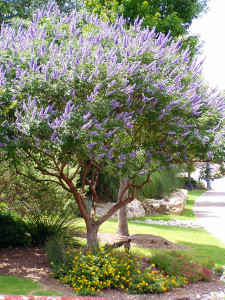
vitex6One of my favorite plants I look for in spring is the vitex or chaste tree.  It has beautiful purple/lavender cone-shaped blooms and exudes a fragrance that no other tree has.  It’s name is derived from the Latin “vieo” meaning to weave or tie up, a reference to the use of Vitex agnus-castus in basketry.   It is known in both Greek and Latin as “Chaste” since in ancient times it was thought to be an aphrodisiac.

The plant is widely cultivated in warm, temperate climates for its foliage and butterfly/bee-attracting spikes of lavender flowers.  I am told it will grow to a height of 12 feet or more and requires full sun or partial shade along with well-drained soil.  Also, it is hearty to Zone 7.

Additionally, it is a traditional plant of Africa and has a potential to improve nutrition and support sustainable landcare.  It’s flowers and ripening seeds are harvested for medicinal purposes.

For anyone searching for a drought-tolerate tree, this one is for you.  It is also suitable for xeriscaping, and very easily grown.  So, when you happen to be out and about in our area, look for this beauty.  You will find it everywhere, especially in early summer when the beautiful purple flowers are sure to catch your eye.

Here’s a tip:  After the tree produces its flowers, let them die, then clip them off and the tree will produce more flowers.

HAPPY GARDENING !
Filed Under: Current Newsletter, Favorite Plants, Newsletters

Let’s Go To Agaritaville

August 3, 2014 by lheideman

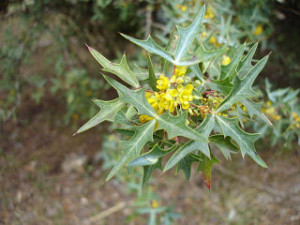
Agarita 3By Sheryl Kleinschmidt, Master Gardener

I don’t know whether or not Jimmy Buffett ever went to Agaritaville, but if he’d ever tasted the wine, I’m sure he’d return and play his six-string for us!

The first time I can remember seeing agarita (Berberis trifoliate), was at my great uncle’s ranch down in south Texas on the Nueces River.  The landscape there reminds me a lot of Somervell County except there are no hills—it’s as flat as a pancake.  The caliche soil there lends itself to the proliferation of agarita just as the shallow limestone soil does here.

Uncle Louis was an old-time rancher who lived off the land as much as possible.  I can remember being intrigued by some of the things he would show and tell me from time to time when I visited him.  Once he showed me the agarita shrubs and told me that he and his family had always collected the little, red berries by placing an old sheet under the bushes and beating them with a stick.  But, it was a game of cat and mouse to get to the berries before the birds ate them all!

His family would then either make homemade jelly or wine, which they coveted.  It took a lot of those tiny berries to make enough juice for either.

Agarita grows 3’-6’ tall with a spread about the same size.  Its foliage is bluish-green and resembles holly.   Small yellow flowers begin to develop some time around February attracting honeybees and butterflies alike.  The red fruit sets not long thereafter.

Being a Texas native, agarita requires little water.  The deer do not like its prickly leaves, but they make a good habitat for nesting birds.

If you are fortunate enough to have agarita on your property (or a friend’s) you might develop a real palate for either the wine or the jelly.  Below is a recipe for agarita jelly which is stored in the freezer rather than put into a water bath and canned.

AGARITA JELLY

Gather enough berries to make two quarts.  Wash thoroughly, removing any debris such as leaves, stems, etc.  Put berries into a large pot and cover with water.  Bring to a boil and steep until the berries begin to pop open.  Remove from the heat.  Using a potato masher, squash the juice out of the berries.

In another pot, bring 4 cups agarita juice to a boil.  Add 3 cups of sugar, let it come to a boil again, then add one box of No-Sugar Needed Fruit Pectin.  Boil for one minute, cool and pour into freezer containers.  Keep frozen til needed.

~****~

“Wasted away in Agaritaville,

Searchin’ for my last spoonful of jel-ly….”


Filed Under: Current Newsletter, Favorite Plants, Newsletters

The Beginning of Paper

July 6, 2014 by lheideman

by Katie Hunholz, Somervell County Master Gardener Intern 

With the current trend of viewing documents on the internet, writing letters via email, and reading books on ipads or Kindles, paper is slowly becoming a thing of the past.  However, I believe that paper will never completely disappear, due to people who prefer being able to feel the paper in their hands rather than read it on a screen (I, myself, am one of those old-fashioned readers).  I wouldn’t call myself a ‘tree-hugger’, but I do value trees for all the amazing materials they provide us, and for their beauty, and the part they play in the ecosystem.  However, paper wasn’t always dependent on trees; it originally came from Cyperus papyrus.

The word ‘paper’ is derived from the Egyptian word ‘papyrus’.  Paper- a thin, flexible material in sheets, made from rags, wood, etc., and used for printing or writing on (Webster’s New World Dictionary)– was first made from the papyrus plant, which originates from Ethiopia and Egypt.  Papyrus, also known as Nile grass, or paper reed, can reach up to 15 feet tall, growing in water depths up to 3 feet.  Despite its willowy appearance, the stem of papyrus was often woven into baskets, or even boats.  With both strength and flexibility, papyrus was valued as a building material and a writing medium.

The use of papyrus as a paper originated with the Egyptians, about 4000 years ago.  Paper made from papyrus comes from the pith, or core, of the plant.  The pith is gently peeled into strips, which are then laid out in two layers, with the second layer being laid on top of the first layer, but at a 90 degree angle.  The sugary sap from the plant acts as a natural glue, combining the two layers as they dry.  The front side of the paper was always the side with the horizontal strips, not the side with the vertical strips.  As other nations began to desire a way to transcribe their written language, the use of papyrus quickly spread; it was especially popular with the Greeks and Romans.   Even after parchment was developed (a type of paper made from animal skin), papyrus was still desirable.  However, the use of papyrus slowly began to fade beginning around 800 AD.  

The creation of paper, beginning with papyrus, allowed countries to advance in culture and technology.  Previously people had no way of communicating except through their spoken language.  It’s difficult to imagine a world with no written documents, but without papyrus that would be our world.  Unfortunately, papyrus is now rarely used as a paper, or as a building material.  Its lack of use has led to papyrus being an endangered plant; perhaps it is time to begin the cultivation of papyrus once again.  It would be a shame to lose such a significant plant with its historical, cultural, and technological value. 

Sources:

Laws, Bill. 2010. Fifty Plants that Changed the Course of History.  Quid Publishing. pp. 62-63. 

Seid, Timothy. (2004). Papyrus. Interpeting Ancient Manuscripts.[Online]. Available: http://legacy.earlham.edu/~seidti/iam/papyrus.html.[7/14] 

Filed Under: Favorite Plants, Newsletters

Where Do Cashews Come From?

May 10, 2014 by lheideman


by Sheryl Kleinschmidt, Somervell County Master Gardener  Ever wonder where cashews come from?  You might think they grow inside a shell like any other nut, but their true origins are far more bizarre. 

cashews,2First of all, cashews are not actually nuts, but rather fruits from the cashew tree, a large evergreen tree that thrives in tropical climates.

The tree produces red flowers, which in turn produce yellow and red oval structures resembling apples.

These so-called cashew apples are very juicy and pulpy, and their juice is often added to tropical fruit drinks. 

However, cashew apples are not actually fruits in a scientific sense; the real fruit of the cashew tree is the kidney-shaped formation growing at the end. cashews, 3

These fruits, also called drupes, are harvested and become what we know as a cashew nut. 


In their raw form, the other layer of the fruit contains multiple toxins,including anacardic acid, a powerful skin irritant similar to the toxin found in poison ivy that must be removed prior to eating.  Roasting the cashews destroys the toxins, but roasting must be performed carefully outdoors because the smoke can irritate the lungs, sometimes to a life-threatening degree. cashews, 5

When they are roasted, cashews change from their natural greenish-gray color to the light brown nut sold in stores. cashews

Next time you crack open a tin of cashews, take a moment to appreciate the long journey those little c-shaped nuts took from the tree to your table!


Filed Under: Favorite Plants, Newsletters

Favorite Flower – Texas Bluebonnet

April 11, 2014 by lheideman

by Merilyn Cranford, Somervell County Master Gardener

DSC_4941, bluebonnets

          As spring is just around the corner, be on the lookout for the Texas Bluebonnet.  This  Texas trademark is to Texas what a shamrock is to Ireland.  The Texas Bluebonnet,  or lupines texensis, is the state flower as all Texans know.  Native American (Texans)  wove fascinating folk tales around this special wildflower, crediting them with  everything from having natural medicinal qualities to being spiritual messengers  from the heavens.     

             Just how this delicate blue beauty became the official state flower is a little-known  story.  In 1901, when the issue was up for a vote in the state legislature, the  bluebonnet was running second to the cotton flower and the bloom of the Prickly  Pear advocated by John Nance Garner who later became vice-president of the United States.  However, his efforts were unsuccessful and bowed to the lobbying efforts of a ladies group who made sure the bluebonnet was designated as the official flower of Texas.   

             Those who have tried to grow this beautiful wildflower, understand that patience is the primary ingredient.  Therefore, it may take several years to establish a good stand of bluebonnets in your yard.  For the most successful results, plant the seeds in October through November.  The seeds will germinate in the fall and grow throughout the winter, usually blooming around the end of March to mid-May.  Choose a sunny, well-drained location with slightly alkaline soil.  With a little rain and a lot of patience the results will be a blue blanket of beautiful bluebonnets that return year after year.

Happy Gardening!


Filed Under: Favorite Plants

Hemp: the controversial plant

March 7, 2014 by

by Katie Hunholz, Somervell County Master Gardener Intern

Hemp is a plant you probably have heard about before, but maybe not referred to in the most positive light.  So, what is the big deal with this plant?  Why is the planting of hemp so strictly regulated in the United States (in case you didn’t know it is actually illegal to plant or harvest hemp unless you have a permit from the government to do so)?    And yet, many people strongly promote the growth of this plant and the changing of the strict laws concerning it.  In fact, current research -and past history- have shown that hemp has amazing potential as a sustainable plant, being used to make numerous products with a smaller ecological footprint than plants being currently used. Hemp is an ingredient in many products produced in the United States- products which are not illegal.  It is only the farming of hemp that is illegal, not its use in industry, nor its presence in products sold in the U.S.  However, in order to use hemp to make a product, it needs to be imported from another country- most likely Canada or China.

Taking a brief look at the use of hemp throughout American history, illustrates the importance that this crop has had on our country.   In the past, hemp was used for making paper (used for the Declaration of Independence), car parts (by Henry Ford, himself), clothing (including the first pair of jeans), and rope.   After cotton became easier to harvest, the popularity of hemp in the U.S. greatly declined.  However, the production and use of hemp  increased from 1 million pounds per year to 150 million pounds per year during World War II, with the need for war materials made in the U.S.  After the war, production of hemp decreased to only 3 million pounds; a decrease which continued until the eventual outlawing of production.   But, obviously hemp was an item that was greatly valued at one time- a value that has begun to increase throughout the past few decades.

The green potential that hemp could provide in the future seems somewhat endless.  If you refer to the attached diagram, you can see the many uses for hemp in the production of numerous products.  Such products include food, flour, fuel, paint, cosmetics, shampoo, fabric, carpeting, and building materials.  There are numerous advantages to using hemp in these materials.  Paper made with hemp is resistant to mildew, while the amount of pulp produced by hemp is more per acre than that produced by timber.   Hemp oil is extremely nutritious, having high amounts of essential fatty acids (which our bodies do not produce), B-vitamins, dietary fiber, and protein.  In fact, only soybeans have a greater amount of protein than hemp, and hemp is more easily digested than soybeans.  With only eight species known to naturally prey on hemp, hemp can be organically grown- free of pesticides, herbicides, and insecticides.  It even makes an ideal rotational crop for farmers since it is a natural weed suppressor.  Hemp is a very rapid grower which can be harvested only three months after being planted.  The possibilities for hemp are extensive, yet despite its usefulness, there remain numerous objections to its legalization as a crop.

What are these objections, and why are hemp’s adversaries so adamant against it?  The issue actually lies with a different cultivar of Cannabis sativa- marijuana.  Despite the fact that hemp contains less than 1% of the chemical delta-9 tetrahydrocannabinol (THC), which is the psychoactive element that marijuana is known for, and that it has an entirely different genetic make-up, both varieties are able to cross-pollinate, and they are the same species.  There are several distinct characteristics- beyond the presence of THC- that set hemp apart from its close relative.  Hemp is grown as a tall, single stalk, with the plants being grown close together.  Marijuana is a much shorter plant, in which bushy leaves and branches are encouraged, and the spacing between plants is less dense than hemp.  Therefore, it is the fear of marijuana, hemp’s ‘brother’, that deters the planting of hemp and its legalization.

With the United States being the only industrialized nation that does not permit the production of hemp, and several states within the U.S. already making hemp’s production legal within their state, it seems inevitable that industrial hemp may soon become a common crop within our nation.  In fact, recent regulations have passed through Congress that permit the production of hemp for strictly research/educational purposes within higher education institutions.  Whether the legalization of hemp is a positive or negative direction for our nation, is a question that soon will be answered.


Sources Cited:

  • Hemp Industries Association. (1994). Facts. (online). Available: http://www.thehia.org/facts.html
  • Johnson, R. (6/2013). Hemp as an Agricultural Commodity. Congressional Research Service. (online). Available: http://www.fas.org/sgp/crs/misc/RL32725.pdf.
  • Laws, B. 2012. Fifty Plants that Changed the Course of History. New York. Firefly Books.
  • Holleman, J. (2/2014). Industrial hemp farming wins first approval in S.C. Senate. Herald online. (online). Available: http://www.heraldonline.com/2014/02/20/5698639/industrial-hemp-farming-wins-first.html.

Filed Under: Favorite Plants, Newsletters

Sunflowers

January 31, 2014 by lheideman


by Katie Hunholz, Somervell County Master Gardener Intern

sunflowerThe Sunflower, a native of North America, is another plant that has a rich history of being utilized by the human race.  First cultivated by the Native Americans, the sunflower was brought to Europe by the Spanish, during the early years of North American exploration.  After being extensively researched and cultivated in Russia, the sunflower gradually made its way back to North America, where it continued to be utilized in the areas of food, industry, and transportation.

Originally, sunflowers were greatly valued for their use as flour in cakes and bread, and as a medicinal ointment used in the treatment of snakebites or dry skin.  The stalks were used as a building material, especially useful in areas that lacked large expanses of timber with which to build housing, and in weaving baskets.  The Native Americans were known to extract a yellow and black dye, which was used as a body paint, from the petals and flowers of the sunflower.

Over time, however, sunflowers became valued in many other ways, including their aesthetic quality.  Not only are fields of sunflowers a vision of beauty, and the inspiration behind the paintings of Vincent Van Gogh, but they play a vital role in many areas of our everyday lives.  For example, sunflower oil is highly valued in the food industry as a natural source of margarine and cooking oil- often used in frying or baking.  In fact, it is the only oil that naturally produces margarine with a rich, yellow coloring.  The seeds of the sunflower are valued as a nutritious snack, which provide a rich variety of vitamins, minerals, and fatty acids- for both humans, and birds!   Despite being an expensive ingredient, due to its high demand by the cooking industry, sunflower oil has found its way into many industrial items as well- including, paints, varnishes, plastics, soaps, and detergents.  It even has the potential to be used in biodiesel.  The stems of sunflowers can be used in the production of paper and latex, or they can become a fibrous treat for cattle.  One very unique use of the sunflower has been the use of the sunflower pith, used as a buoyancy device- such as a life preserver.  In fact, the life preservers used on the Titantic were apparently filled with sunflower pith! Recently, sunflowers were even used in the process of phytoremediation- whereby toxins such as arsenic and lead, are removed from the soil.

Sunflowers, as a cultivated species, can come in various colors and sizes- usually 5-12 feet in height.  The flower itself is actually made up of numerous tiny florets.  Ray florets eventually develop into the petals, whereas the disc florets are the ones inside of the sunflower’s flower head, and they produce the seeds of the sunflower.  A favorite of many gardeners, sunflowers are known for being drought tolerant and resistant to deer.  With all of the amazing qualities of a sunflower, it is somewhat puzzling to discover that despite the sunflower’s origination being in North America, the sunflower is actually much more popular, and prevalent, in Europe.   Such a useful, yet beautiful, plant deserves to be admired and preserved for future generations.  Hopefully, this article will encourage you to appreciate this amazing flower, and all it has to offer- not only in the past, but so much more in our future.


Sources:

  • Laws, Bill. 2012.  Fifty Plants that Changed the Course of History.  New York. Firefly

Books, Inc. p. 94-97.

  • National Sunflower Association. (2014). Sunflower Sustainability: The substance behind the seed. (online). Available: www.sunflowernsa.com (2014, January 30).

Filed Under: Favorite Plants

Night-Blooming Cereus

December 5, 2013 by Donna Hagar

By Merilyn Cranford, Somervell County Master Gardener

cereus2About 4 or 5 years ago, my sister-in-law (a Tennessee Master Gardner) asked me if I had ever grown a night-blooming cereus.  Not knowing just what she was talking about, we went out to her garden and she cut off a leaf of her existing plant. It was one of the ugliest plants I had ever seen, but I acted like she had given me a family treasure.  However, she patiently explained that the plant blooms only at night or in the early, early morning.

cereus3So I went home and gave this newest addition to our home a lot of TLC.  Well, to my surprise, the thing didn’t bloom right away, but much later…two years later!!  I couldn’t believe this prize possession was finally going to bloom.  So we watched as the first bud appeared, and every morning thereafter we patiently checked its progress.  The occasion held us in suspense, and after around 8 to 10 days after making our regular check in the morning…..there it was in all its glory.  What a beauty!!

cereus4As the pictures show, the bloom was sparkling white and nearly as large as my husbands hand.  It was truly a blessing worth waiting for.  Hope the pictures spark some interest to others who might want to try growing one.  Enjoy!!

Night-Blooming Cereus or Epiphyllum oxypetalumis a species of cactus and one of the most cultivated species in the genus.


Filed Under: Favorite Plants, Newsletters

Esperanza – Favorite Plants of Master Gardeners

October 10, 2013 by Donna Hagar

Esperanza or Yellow Bells, Tecoma stans

Submitted by Donna Hagar, Somervell County Master Gardeners

esperanzaHave you been in downtown Glen Rose lately? If so, you surely have seen the large yellow blooming shrub on the north east corner bed of the square by the Coca Cola building. Many folks have asked what this showy shrub is. The answer is an Esperanza or Yellow Bells, scientific name Tecoma Stans. This is a Texas Super Star, and is gaining popularity as an ornamental plant in Texas gardens. In the wild in Texas it can be found growing on rocky slopes near San Antonio and in the Trans-Pecos. This is a cold tender plant, hardy to zone 8b. In our area, if you plant it on the south side of a home or structure, protected it from the north winds, mulched HEAVILY in the winter, it will die back but should come back from the roots. It can also be used as a fast growing, large container plant which may be moved into warmer winter quarters. The striking, tubular 2 1/2-inch bright yellow flowers are highlighted by the attractive, shiny, green foliage and continue through the heat of the summer. The flowers have sweet pleasing fragrance and also provide nectar for bees. Plant with the purple fall aster for an amazing show of contrasting purple and yellow flowers for this time of year.

Plant Habit or Use: small shrub medium shrub
Exposure: sun
Flower Color: yellow
Blooming Period: spring, summer, fall
Fruit Characteristics: 4- to 6-inch-long capsule
Height: 3 to 6 feet
Width: 3 to 4 feet
Plant Character: deciduous,
Heat Tolerance: high
Water Requirements: low
Soil Requirements:
neutral, alkaline

Filed Under: Archived Newsletter 2013-present, Favorite Plants

Iris – Favorite Plant of Master Gardener

September 2, 2013 by Donna Hagar

Submitted by Julie Conner, Somervell County Master Gardener

Louisiana IrisDid you ever drive by an old homestead where only the chimney remained standing. Yet in the corner of the foundation there is a growth of Iris. Why does that Iris come up each year? The Iris is from the family of flowers that grow from a bulb and when planted
in the right spot they require a minimum of care, as the Iris on the old homestead prove.
 
Rhizomes, corms, tubers and bulbs are a group of plants that grow their stems underground. Many of these bulbs require a low temperatures for a period of time before they send up new growth. Most of these plants prefer sunny spots because their leaves need the exposure to sunlight in order to product food which is stored in the bulb for the next season growth.
 
Iris can adapt to almost any soil but for best results prepare a bed for them and in a location that gets at least 6 hours of sun. Allow at least 3 inches of organic matter in the bed then place the bulb approx one inch below the surface then layer 2 inches of mulch on top and water thoroughly.
 
Iris bloom spring through summer depending on variety. Once the blooms have done their thing the bloom stalks can be removed. Do not trim back the leaves or blades much as the bulb still needs to produce food for the bulb. You can fertilize in the spring as new growth appears. A good rule of thumb for the bulb plants “if it blooms in the spring or summer then you will dig, divide and plant in the fall”.
 
There is a large variety of Iris from bearded to dwarfs and range in heights of 3 inches to 27 inches. There is a Ft Worth Iris Society which is having a sale Sept 28th at the Ft Worth Botanical Gardens. This would be a great time to investigate the possibilities of Iris in your garden.

Filed Under: Archived Newsletter 2013-present, Favorite Plants, Newsletters

  • « Go to Previous Page
  • Page 1
  • Page 2
  • Page 3
  • Page 4
  • Go to Next Page »

Upcoming Events

Notice
There are no upcoming events.

Get Updates

Subscribe to Our Newsletter

RSS Recent Posts

  • Master Gardener Presents
  • Allelopathy: The Other Side of Companion Planting
  • Poinsettias – Our Favorite Christmas Plant
  • Arbor Day Means Tree Planting in Texas

Administrator Only

  • Log in
  • Entries feed
  • Comments feed
  • WordPress.org
Texas A&M AgriLife Extension Service
Texas A&M University System Member
  • Compact with Texans
  • Privacy and Security
  • Accessibility Policy
  • State Link Policy
  • Statewide Search
  • Veterans Benefits
  • Military Families
  • Risk, Fraud & Misconduct Hotline
  • Texas Homeland Security
  • Texas Veterans Portal
  • Equal Opportunity
  • Open Records/Public Information