Stephen Brueggerhoff, CEA – Horticulture, Brazos County AgriLife Extension; published 8/18/2026
All images unless otherwise noted by Stephen Brueggerhoff
A little mid-summer garden flair can be easily achieved by choosing from a suite of hardy hybridized hibiscus, stand-out plants that direct our attention with a variety of colors and flower form. I’ll start this article with an introduction to a diverse plant family, and finish with an enticing flourish of hardy hibiscus varieties.
All In the Plant Family
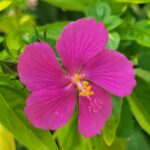
Hibiscus belongs to the Mallow Family (Malvaceae), plants with global distribution of over 240 genera. Plants with economic importance include cotton, okra and cacao. Members of this family certainly stand out in a crowd, each species expressing 5-petaled flowers dressed in bold and bright colors and centered with prominent reproductive organs. What you see is the pistil’s style extending beyond the floral cup with many fused stamens positioned below the pistil’s 5-lobed stigma. They kind of look like a spark at the end of a wand. The family includes Texas natives like Halberd-leaf hibiscus (Hibiscus laevis) that can be found along ditches from the Gulf Coast Prairies to East Texas, drought tolerant Rock rose (Pavonia lasiopetala) found in the Edwards Plateau and readily adaptable to yard gardens, and hummingbird magnet Texas Superstar® and popular shade tolerant shrub Turk’s cap (Malvaviscus arboreus var. drummondii). There are several tropical hibiscus species that have origins in Mauritius, Madagascar, Fiji, Hawaii, China and India and should be cultivated in a container if considered for the Brazos Valley. Modern tropical hibiscus available in retail outlets are selections and hybrids of Chinese hibiscus (Hibiscus rosa-sinensis). Keep in mind that Chinese hibiscus may require supplemental water and planted in well-draining, enriched soil in a frost-protected location to successfully cultivate in your garden.
Hibiscus shrubs that are found in historic southern gardens and are more practical planted in ground are called Althea, also known as Rose of Sharon (Hibiscus syriacus). Naturally distributed in south China to Taiwan and successively cultivated over the century in Europe and North America, Rose of Sharon is adaptable to differing soil profiles once established and thrives in hot weather. They can grow to ten feet tall and have the capacity to expand to six feet wide. Some hybrids like Raspberry Smoothie™ will produce double-blossom flowers, large and frilly offering bright colors that stand alone as a specimen plant.
Bold and Beautiful Research
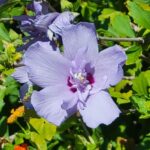
There is a hibiscus hybridization program at Texas A&M AgriLife Extension and Research Center in Vernon, Texas directed by plant physiologist Dr. Dariusz Malinowski, expanding our hibiscus palette with cold hardy varieties hybridized from tropical and native species Swamp rose mallow (Hibiscus moscheutos). Dr. Malinowski and researchers introduced ‘Blue Angel’ in 2012, one of the first true blue hibiscus flowers in a line of hardy hibiscus released commercially. You can view ‘Blue Angel’ and gain inspiration for landscape design while touring the Leach Teaching Gardens at Texas A&M University. The Summer Spice series offers a variety of colors that include introductions ‘Bleu Brulee’, sky blue with red eye; ‘Plum Flambe’ in light plum color; ‘Grape Sorbet’ cheering on with double purple color, and more. You may also consider hibiscus from the Texas Superstar® list such as ‘Moy Grande’, 5-feet tall with rose-pink, dinner-plate sized flowers; or ‘Lord Baltimore’ with red flowers up to 10-inches in diameter. ‘Peppermint Flare’ is served almost as big as a dinner plate, most certainly dressed for the floral occasion and appropriate for seasonal interest.
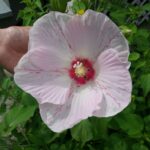
I encourage you to consider adding both tropical and cold hardy hibiscus hybrids to your garden and be the envy of your block. Include Texas native mallows in your garden to promote environmental and ecoregion awareness and cultivate connections with our natural legacy. Browse online to view hardy hibiscus, Texas native plants and more from the Texas Superstar® program at https://texassuperstar.com/. Explore the hardy hibiscus breeding program at the Vernon Research Center at https://vernon.tamu.edu/. Share your experiences with me during my live call-in garden show Garden Success airing weekly on Thursdays at 12 pm on KAMU-FM 90.9. Get your hibiscus flare on, and I always look forward to seeing you in the garden.
