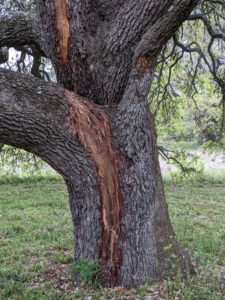
Bark blown off the “Lightning Tree” by lightning strike.
Lightning is a grand display of nature’s power.
Strong thunderstorms rolled through our area in March 2021. Afterwards, we suspected one of the mature live oak trees on our property was hit by lightning. I sent some photos of the tree to Daniel Lewis of the Texas A&M Forest Service. Mr. Lewis confirmed the photos showed a textbook pattern of a lightning strike. He also assured that most trees recover from lightning strike damage with no problem.
About 30,000,000 cloud-to-ground lightning strikes hit in the contiguous 48-states of the United States every year. Although lightning does not always strike the highest point around, it usually does so, according to NOAA’s National Severe Storms Laboratory. This makes tall trees, particularly on a hilltop or in a pasture, more vulnerable to lightning strikes.
NOAA’s NSSL says a typical lightning flash is about 300 million Volts and about 30,000 Amps. In comparison, household current is 120 Volts and 15 Amps. There is enough energy in a typical flash of lightning to light a 100-watt incandescent light bulb for about three months. Lightning heats the surrounding air anywhere from 18,000 degrees Fahrenheit to up to 60,000 degrees Fahrenheit.
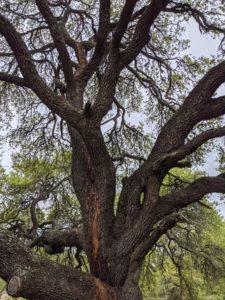
Lightning damage wrapped around the tree.
Lightning traveling down a tree trunk turns water to steam. If it gets under the bark into the surface moisture of the wood, the rapidly expanding steam blasts pieces of bark and branches from the tree, and the wood along the path is often killed. The charge carried by the lightning is then dissipated along the surface of the Earth. This is explained on the NSSL website Severe Weather 101. The photos in this blog show the blasted pieces of bark from our live oak tree.
There are ways to protect trees of significance or that could endanger human life if struck by lightning. For more information go to Texas AgriLife Extension Tree Care Kit, Understanding Lightning & Associated Tree Damage.
One conclusion from the study of our lightning-struck tree (we now refer to it as the “Lightning Tree”) is that a mature Texas live oak tree, even jolted by the immense power of a lightning bolt, is mighty indeed.
By Christy Schweikahrdt